
Bimetal Thermometer: How It Works, Accuracy and Selection
Table of Contents
- What is a bimetal thermometer and how does it work?
- How does a bimetal thermometer work?
- What are the main parts of a bimetal thermometer?
- Every angle vs back connected bimetal thermometer: which should you choose?
- How far should a bimetal thermometer stem be immersed?
- How accurate is a bimetal thermometer?
- How do you calculate bimetal thermometer accuracy? A solved example
- Solved example: hot water return line
- Bimetal thermometer accuracy band calculator
- Can you use a bimetal thermometer in a thermowell?
- What temperature should a bimetal thermometer be calibrated to?
- Why is my bimetal thermometer reading wrong?
- Which bimetal thermometer should I choose over an RTD or gas actuated gauge?
- Pros and cons of a bimetal thermometer
- Pros
- Cons
- Myth vs fact: bimetal thermometer edition
- Industrial applications of the bimetal thermometer
- Refinery
- Water and wastewater plant
- HVAC
- Chemical plant
- Frequently asked questions
- What temperature should a bimetal thermometer be calibrated to in practice?
- How often should you check a dial thermometer against a reference?
- Can a bimetal dial be read remotely or sent to a DCS?
- Why does my dial thermometer read lower than the RTD on the same line?
- What does Grade A accuracy mean on a dial thermometer datasheet?
- Do you need a thermowell for a dial thermometer on water lines?
A bimetal thermometer is the dial thermometer you see on pump discharge lines, heat exchanger outlets and HVAC headers across almost every plant. Below you’ll find how a bimetal thermometer works, how accurate it is and how to pick the stem, connection and range, plus a bimetal thermometer accuracy calculator, a solved example and a field check you can run with a reference bath.
What is a bimetal thermometer and how does it work?
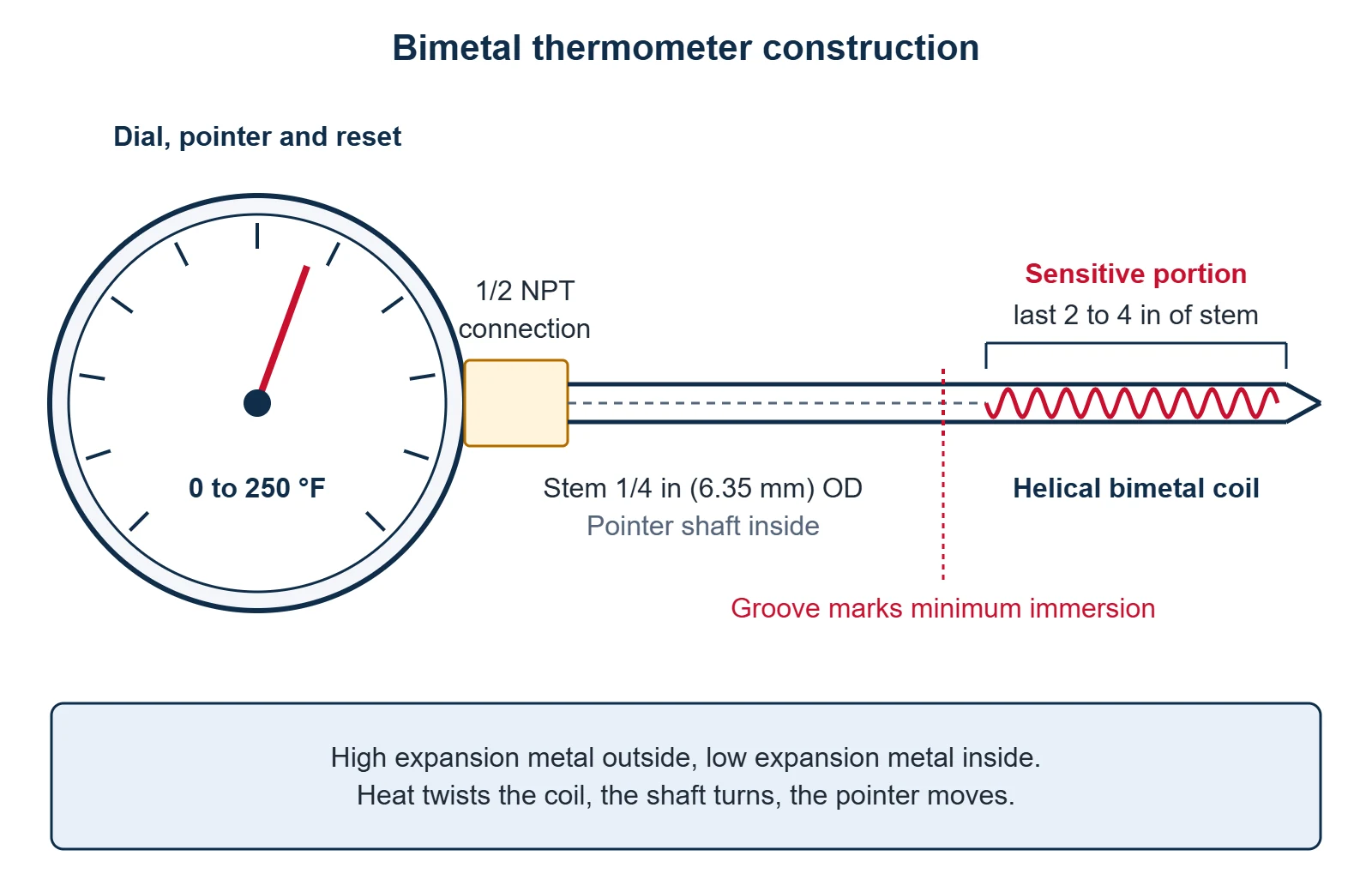
A bimetal thermometer is a mechanical dial thermometer that senses temperature with a coil made of two bonded metals that expand at different rates. When the stem heats up, the coil twists, a shaft turns, and the pointer moves across the dial with no power, wiring or transmitter, which makes it a simple local indicator for pipes, tanks and ducts.
How does a bimetal thermometer work?
A bimetal thermometer works on unequal thermal expansion: two metal strips bonded together bend when heated because one grows more than the other. Wound into a helix, that bending becomes a twist that turns the pointer.
The bimetallic strip goes back to clockmaker John Harrison, who used one in his H3 marine chronometer of 1759. Wikipedia notes that a coiled strip gives better sensitivity because it packs more length into a small space, which is why every bimetal thermometer uses a coil.
The metal pair matters. Engineering ToolBox lists linear expansion coefficients for common metals of 0.67 × 10⁻⁶ in/in·°F for Invar and 11.3 × 10⁻⁶ in/in·°F for yellow brass, a ratio of almost 17 to 1.
Over a 100 °F (55.6 °C) rise, a 10 inch (254 mm) brass strip grows about 0.0113 inch while the Invar side grows only 0.00067 inch. Bonded together, that difference forces the bimetal thermometer coil to curl.
Inside a bimetal thermometer, one end of the helical coil is fixed at the stem tip. The free end turns a pointer shaft that runs up the stem to the dial.
What are the main parts of a bimetal thermometer?
A bimetal thermometer has a case and dial, a pointer with reset, a stem with its connection, and the helical coil at the stem tip. Each part is a line item on the bimetal thermometer datasheet.
| Part | What it does | Typical datasheet options |
|---|---|---|
| Case and dial | Holds the scale and protects the movement | 2, 3 or 5 inch dial, stainless case, glass or plastic window |
| Pointer and reset | Shows the reading; the external reset shifts the pointer | External reset screw on most industrial models |
| Stem | Carries the coil and the pointer shaft into the process | 1/4 inch (6.35 mm) OD standard, lengths from 2.5 inches (63.5 mm) up |
| Connection | Threads into a thermowell or fitting | 1/2 NPT most common, 1/4 NPT, plain or union |
| Helical coil | Turns temperature into rotation | Silicone dampened coil for vibration |
Trerice’s design notes list bimetal thermometer stems from 2.5 to 72 inches (63.5 to 1,829 mm) long. They also say the case should not see sustained temperatures above 200 °F (93 °C).
WIKA notes that silicone oil filling damps pointer flutter but limits a bimetal thermometer to 482 °F (250 °C).
Every angle vs back connected bimetal thermometer: which should you choose?
Choose a back connected bimetal thermometer when the stem points straight at the viewer, and an every angle bimetal thermometer when the dial must tilt to face the operator.
A back connected bimetal thermometer has the stem at the center rear of the case, which suits horizontal pipe. A bottom connected unit puts the stem under the case, so it reads well on a riser or tank top.
An every angle bimetal thermometer has a hinged joint between case and stem, and Reotemp’s datasheet says its dial adjusts through 90°. Ashcroft warns that turning the case of an adjustable angle model may affect accuracy, so check the reading after you set the angle.
How far should a bimetal thermometer stem be immersed?
Immerse the stem past the sensitive portion, which is the last 2 to 4 inches (50.8 to 101.6 mm) of the stem. Reotemp gives a minimum of 2 inches (50.8 mm) in liquid and 4 inches (101.6 mm) in gas for most ranges.
The coil only fills the stem tip. If part of it sits outside the process, the bimetal thermometer averages process and ambient temperature and reads low on hot lines.
Some ranges need up to 4 inches (101.6 mm) in liquid and 5 inches (127 mm) in gas, per the same sheet. NoShok cuts a groove around each stem to mark the minimum immersion point.
How accurate is a bimetal thermometer?
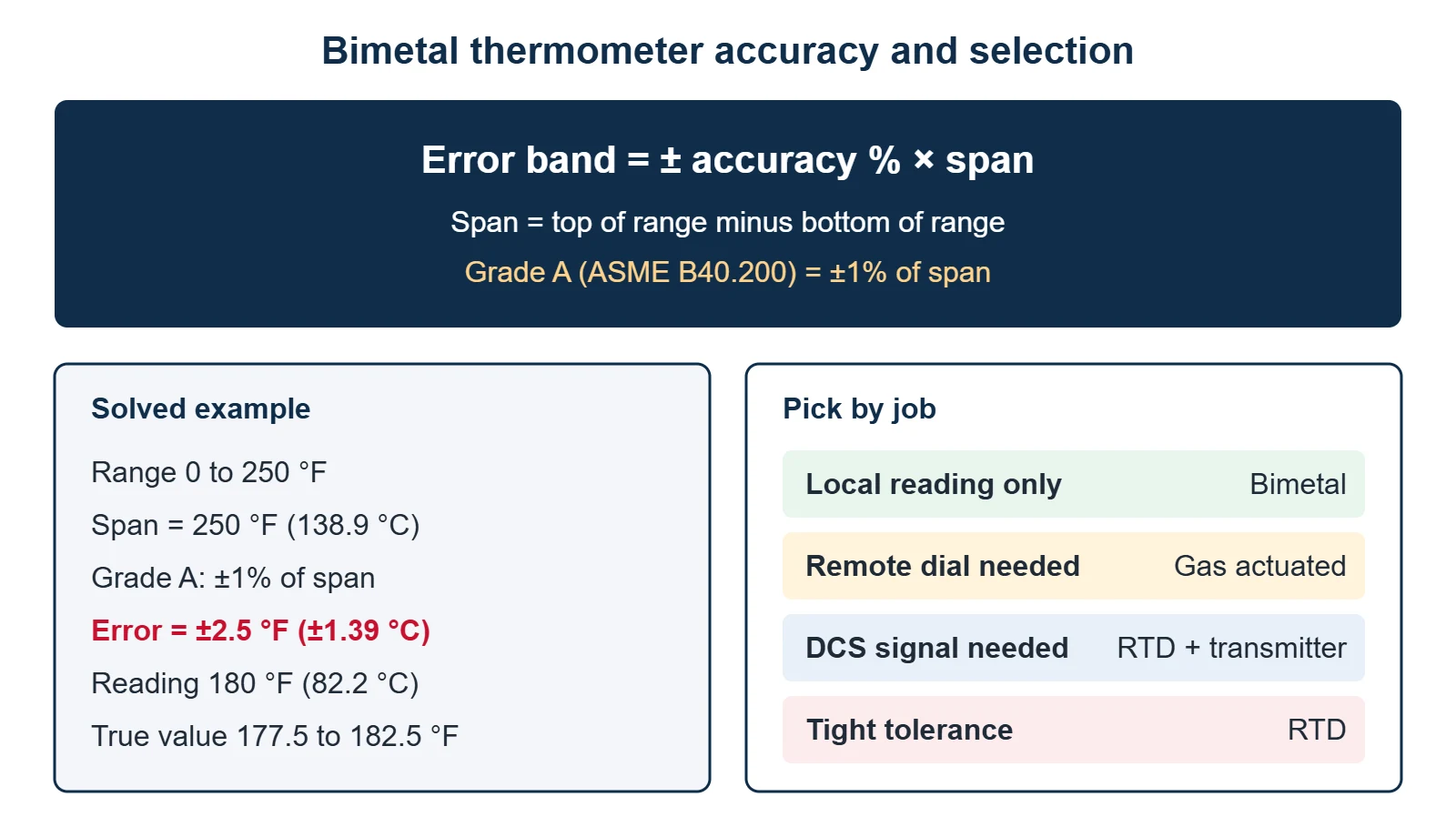
A typical industrial bimetal thermometer is accurate to ±1% of span, which ASME B40.200 calls Grade A. On a 0 to 250 °F range that is ±2.5 °F (±1.39 °C) anywhere on the dial.
ASME B40.200, Thermometers, Direct Reading and Remote Reading, consolidated four older standards, including B40.3 for bimetallic thermometers and B40.9 for thermowells. If you work with several instrument codes, this overview of instrumentation and control standards shows where it sits.
The standard grades accuracy from AA to D. Ashcroft, Trerice and Reotemp all rate a standard industrial bimetal thermometer at ±1% of span, written on Ashcroft’s sheet as “ASME B40.200 (B40.3 Grade A).”
Watch the word span: pick a range much wider than the job needs and you give up accuracy. We make the same point about pressure gauge accuracy grades.
How do you calculate bimetal thermometer accuracy? A solved example
Multiply the span by the accuracy percent to get the plus or minus error band, then apply it to the reading. The example below uses a 0 to 250 °F Grade A dial reading 180 °F.
Solved example: hot water return line
Given: a bimetal thermometer with a 0 to 250 °F (−17.8 to 121.1 °C) range, Grade A accuracy of ±1% of span, reading 180 °F (82.2 °C).
- Span = 250 − 0 = 250 °F (138.9 °C of temperature difference)
- Error band = 1% × 250 °F = ±2.5 °F (±1.39 °C)
- Low limit = 180 − 2.5 = 177.5 °F (80.8 °C)
- High limit = 180 + 2.5 = 182.5 °F (83.6 °C)
- Result: the true temperature lies between 177.5 and 182.5 °F (80.8 to 83.6 °C)
On a 50 to 550 °F bimetal thermometer the band doubles to ±5 °F (±2.78 °C), or 295 to 305 °F (146.1 to 151.7 °C) at a 300 °F reading, even though the grade is the same.
Bimetal thermometer accuracy band calculator
If the bimetal thermometer error band is wider than your process tolerance, choose a narrower range or move to an RTD.
Can you use a bimetal thermometer in a thermowell?
Yes, and on any pressurized or corrosive line you should. Ashcroft recommends a thermowell on all pressurized applications over 15 psi (1.03 bar), so you can pull the bimetal thermometer without draining the line.
A thermowell adds wall thickness and an air gap, so heat reaches the coil more slowly. Trerice recommends heat transfer paste on the sensing portion; this article on conduction, convection and radiation explains why an air gap slows things down.
Match the bimetal thermometer stem to the well so the tip nearly touches the bottom of the bore. Our guide to thermowell types and applications covers well styles, and fast lines also need a wake frequency check.
What temperature should a bimetal thermometer be calibrated to?
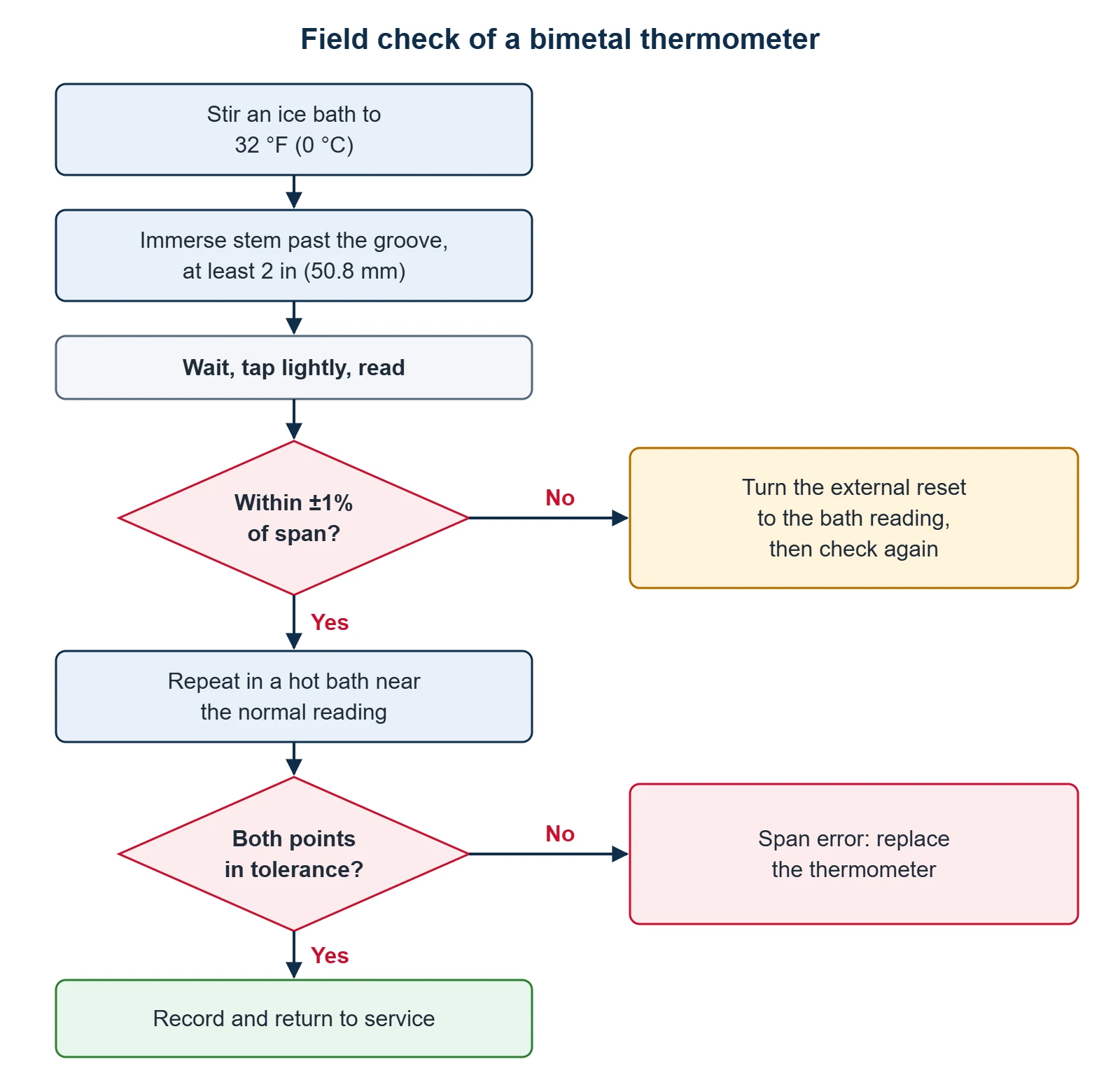
Check a bimetal thermometer at the ice point, 32 °F (0 °C), then at a second point near the normal reading. Food safety guides use 32 °F and 212 °F (100 °C).
Texas A&M AgriLife Extension describes the ice point and boiling point method: immerse the stem at least 2 inches (50.8 mm), wait, and accept a reading within ±2 °F. Boiling point drops at altitude, so do not assume 212 °F.
In a plant, use a stirred bath or dry block plus a calibrated reference probe. Compare the bimetal thermometer at two points and use the external reset if only one point is off.
If both points are off by different amounts, the coil has a span error the reset cannot fix, so replace the bimetal thermometer. Log as found and as left readings as you would for an RTD calibration.
Why is my bimetal thermometer reading wrong?
A bimetal thermometer usually reads wrong because of shallow immersion, a shifted pointer after a knock or overheat, or a slow thermowell.
| Symptom | Likely cause | Fix |
|---|---|---|
| Reads low on a hot line | Sensitive portion not fully immersed | Use a longer stem or deeper well so 2 inches (50.8 mm) or more sits in liquid |
| Same offset at every point | Pointer shifted by shock or overrange | Check against a bath and turn the external reset |
| Offset grows across the range | Coil damaged by overheating | Replace; the reset cannot fix span error |
| Pointer flutters | Pump or piping vibration | Fit a silicone dampened or liquid filled model |
| Slow to respond | Air gap in the thermowell | Add heat transfer paste and check stem to well fit |
| Fogged window | Seal failure, moisture inside case | Replace with a hermetically sealed case |
Trerice allows 100% of span over range for a bimetal thermometer up to 250 °F (121 °C), but only 50% above that. Continuous use above 800 °F (427 °C) may damage it.
Which bimetal thermometer should I choose over an RTD or gas actuated gauge?
Choose a bimetal thermometer for a local reading within about ±1% of span. Pick an RTD for a control system signal or tighter tolerance, and a gas actuated gauge when the dial sits far from the process.
WIKA notes that a bimetal thermometer costs less than a gas actuated one, while gas actuated models reach up to 197 ft (60 m) of capillary.
When the value feeds alarms or the DCS, use an RTD or thermocouple with a temperature transmitter. Our comparison of RTDs and thermocouples helps you pick the sensor, and many sites fit a bimetal dial beside an RTD assembly as a cross check.
Set the bimetal thermometer range so the normal reading falls in the middle third of the scale. Kleev's temperature gauges come in several dial sizes and stem lengths.
Pros and cons of a bimetal thermometer
A bimetal thermometer is cheap, simple and needs no power. Its weak points are accuracy and the lack of a remote reading.
Pros
- No power, wiring or transmitter needed
- Low cost compared with gas actuated or electronic sensors
- Wide scale choice, from −94 to 1,112 °F (−70 to 600 °C) on WIKA models
- External reset allows a quick field correction
- Fits a standard thermowell for removal under pressure
Cons
- Typical accuracy only ±1% of span
- Local reading only, no signal to a control system
- Slower response than a bare sensor, more so in a thermowell
- Coil can take a permanent set after overheating
- Case temperature limited to about 200 °F (93 °C)
Myth vs fact: bimetal thermometer edition
A few shop beliefs cause most bad bimetal thermometer readings.
The whole stem senses temperature, so any insertion depth works.
Only the last 2 to 4 inches of stem hold the coil, and Reotemp sets a 2 inch (50.8 mm) minimum in liquid.
A ±1% dial is accurate to 1% of whatever it reads.
Grade A means ±1% of span, so a 0 to 250 °F dial is ±2.5 °F (±1.39 °C) even at 50 °F.
The reset screw can fix any bad reading.
The reset shifts the pointer by a fixed amount, so it corrects offset only, never span error.
Liquid filling makes a dial suitable for any temperature.
WIKA limits silicone filled units to 482 °F (250 °C) because of the fill.
Industrial applications of the bimetal thermometer
You find the bimetal thermometer wherever operators need a local reading without power.
Refinery
Operators read cooler outlet temperatures on rounds from a 5 inch bimetal thermometer in a flanged thermowell, a quick check on the DCS value.
Water and wastewater plant
Digester heating loops and blower discharge lines carry a back connected dial that needs no power in wet areas.
HVAC
Chilled and hot water headers carry a dial at each coil inlet and outlet to check delta T at a glance.
Chemical plant
Jacketed reactor return lines use a silicone dampened bimetal thermometer in a stainless thermowell to ride out agitator vibration.
Frequently asked questions
What temperature should a bimetal thermometer be calibrated to in practice?
Check a bimetal thermometer at the ice point, 32 °F (0 °C), because a stirred ice bath is easy to make anywhere. For plant work, add a second point near the normal process reading using a bath and a reference probe, so you catch both offset and span error.
How often should you check a dial thermometer against a reference?
No single interval fits every site, so base it on duty. A yearly two point check suits most utility lines, while dials on safety related or high vibration service deserve a shorter interval. Also check any dial after a known overheat, a mechanical knock or a fogged window.
Can a bimetal dial be read remotely or sent to a DCS?
No. A bimetal dial shows the reading only at the case, because the coil drives a pointer shaft, not a signal. For remote reading you need a gas actuated thermometer with a capillary, or an RTD or thermocouple with a transmitter wired back to the control room.
Why does my dial thermometer read lower than the RTD on the same line?
The usual reason is shallow immersion, so part of the coil sits near cooler ambient air. A loose fit in the thermowell with no heat transfer paste adds lag. Check that at least 2 inches (50.8 mm) of stem sits in the liquid before you adjust the reset.
What does Grade A accuracy mean on a dial thermometer datasheet?
Grade A under ASME B40.200 means the error stays within ±1% of the full span at any point on the dial. On a 0 to 250 °F range that is ±2.5 °F (±1.39 °C), whether the pointer reads 50 °F or 240 °F, so a narrower range gives a tighter band.
Do you need a thermowell for a dial thermometer on water lines?
On any pressurized line, yes. Ashcroft recommends a thermowell for all pressurized applications over 15 psi (1.03 bar), which covers most water mains and HVAC loops. The well protects the stem from corrosion and impact and lets you remove the dial without draining or isolating the line.