

What Is Reynolds Number? Formula, Flow Regimes & Calculator
Table of Contents
- What is Reynolds number in simple terms?
- What does Reynolds number tell you about pipe flow?
- Who discovered the Reynolds number?
- What is the Reynolds number formula?
- How do you calculate Reynolds number for water in a pipe?
- Solved example: cooling water in a 3 inch line
- Why does Reynolds number matter for flow meter accuracy?
- How do you use Reynolds number to select a flow meter?
- How does temperature change the Reynolds number?
- What problems does a low Reynolds number cause in the field?
- Pros and cons of Reynolds number checks
- Pros
- Cons
- Myth vs fact about Reynolds number
- Industrial Applications of Reynolds number
- Refinery
- Water and wastewater plant
- HVAC
- Chemical plant
- Frequently asked questions
- What is a good Reynolds number for a vortex flow meter?
- Is Reynolds number really dimensionless or does it have units?
- Why is 2,300 used as the laminar limit in pipe flow?
- Which pipe diameter should I use in the Reynolds formula?
- How does viscosity affect turbine flow meter readings at low flow?
- Can I calculate Reynolds number from gpm and pipe size only?
Reynolds number is the single value that tells you whether the liquid or gas in your pipe is flowing in smooth layers or in a churning, mixed stream. If you size, install or troubleshoot flow meters, it is the first number to check before you trust any reading.
The formula below works in US field units (gpm, inches and centipoise), and the calculator uses the same inputs, so you can check your own lines as you read.
What is Reynolds number in simple terms?
Reynolds number is a dimensionless ratio of inertial forces to viscous forces in a moving fluid, written Re = ρVD / μ. In pipe flow a Reynolds number below about 2,300 means smooth laminar flow, above about 4,000 means turbulent flow, and the band between is transitional, which is why flow meter vendors quote a minimum Reynolds number for accurate readings.
What does Reynolds number tell you about pipe flow?
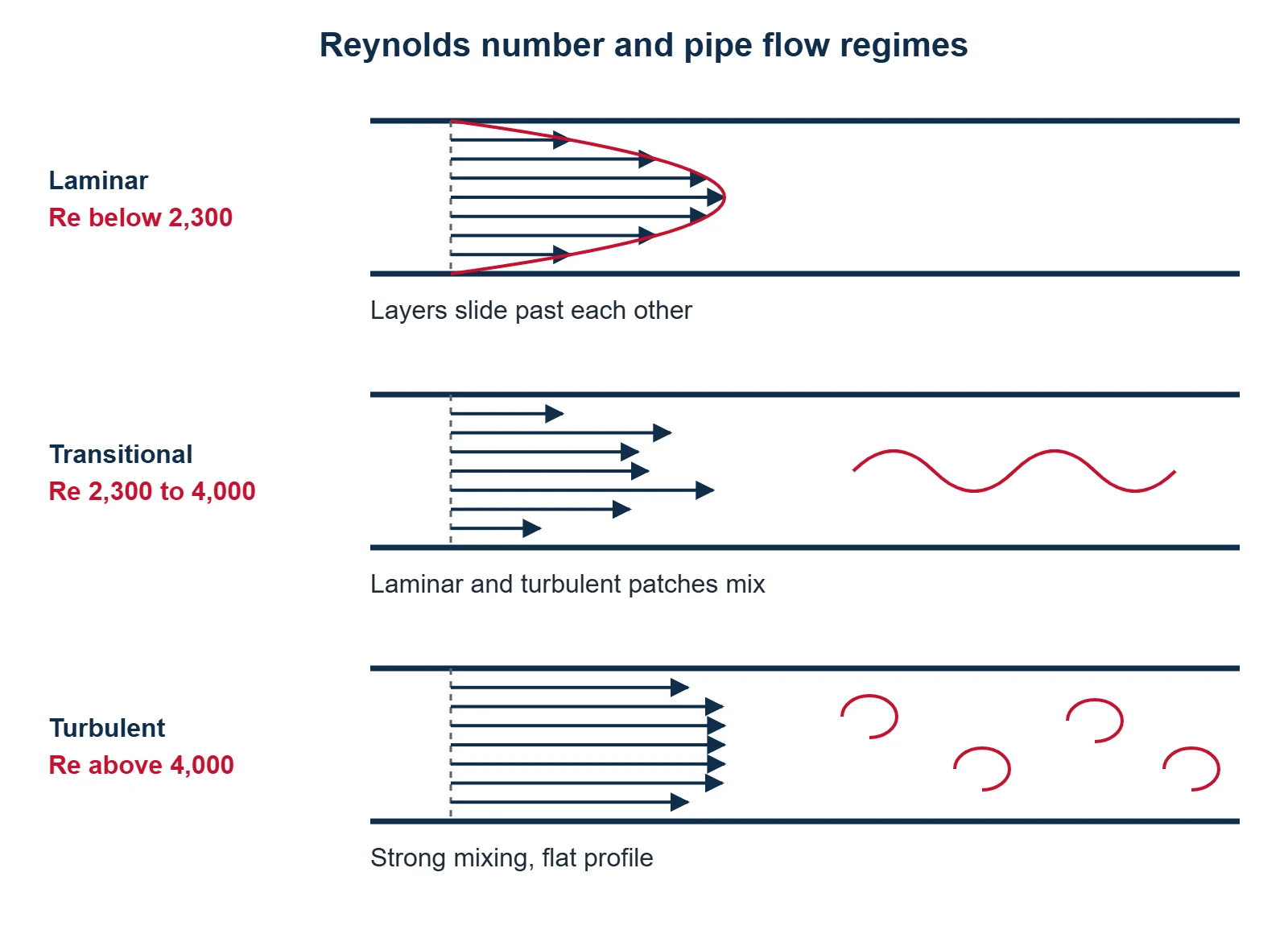
The Reynolds number tells you which flow regime you have: laminar, transitional or turbulent. That regime sets the velocity profile across the pipe, and the profile decides how most flow meters behave.
Engineering ToolBox gives the usual pipe limits as laminar below 2,300, transient from 2,300 to 4,000 and turbulent above 4,000. It also notes that true laminar flow in practice shows up mainly with viscous fluids.
| Reynolds number range | Flow regime | What you see in the pipe |
|---|---|---|
| Below 2,300 | Laminar | Fluid moves in layers, peak velocity at the center, near zero at the wall |
| 2,300 to 4,000 | Transitional | Laminar and turbulent patches come and go, readings can wander |
| Above 4,000 | Turbulent | Strong mixing, flatter velocity profile across most of the bore |
| Above about 10,000 | Fully developed turbulent | Stable profile that most inferential meters are calibrated for |
Wikipedia’s summary of pipe flow research puts laminar flow below a Reynolds number of 2,300 and turbulent flow above 2,900, with intermittent flow in between. So treat the 2,300 to 4,000 band as a gray zone, not a hard line.
Who discovered the Reynolds number?
George Stokes introduced the idea in 1851, but Osborne Reynolds made it popular in 1883 with his dyed water experiments in glass pipes. Arnold Sommerfeld gave the Reynolds number its name in 1908.
Reynolds watched a thin streak of dye stay straight at low speed and then break up and spread across the tube as speed rose. That simple test is still the clearest picture of what the Reynolds number measures, and Zenta Engineering walks through the theory and derivation behind it.
What is the Reynolds number formula?
The Reynolds number formula is Re = ρVD / μ, or Re = VD / ν when you use kinematic viscosity. For pipe work the length term D is the pipe inside diameter, not the nominal size.
Re = ρ × V × D / μ = V × D / ν
ρ = density, V = average velocity, D = pipe inside diameter
μ = dynamic viscosity, ν = kinematic viscosity (ν = μ / ρ)
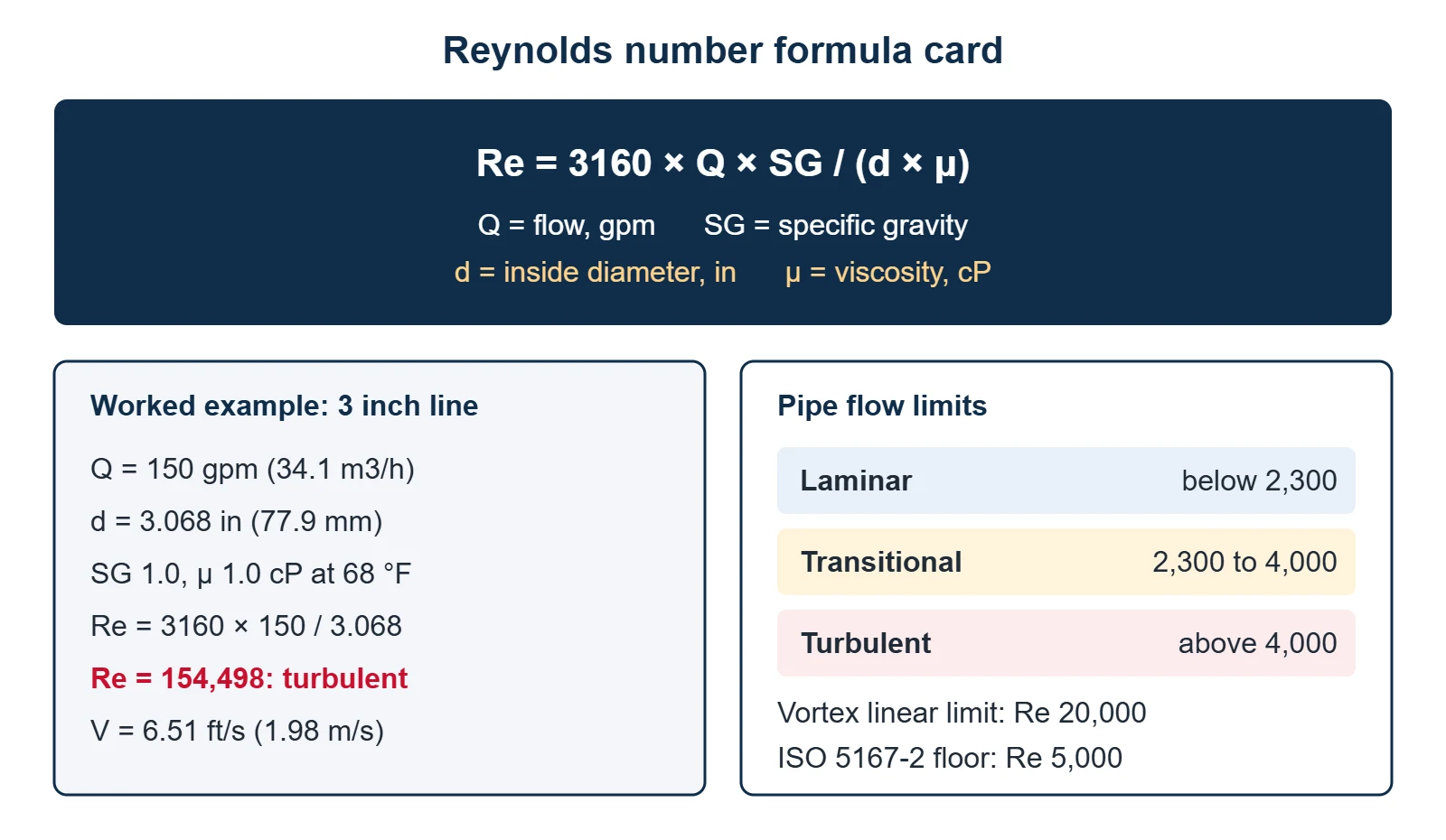
US field form: Re = 3160 × Q × SG / (d × μ)
Q = flow, gpm; SG = specific gravity; d = ID, inches; μ = viscosity, cP
Use consistent units in the base form, such as kg/m3, m/s, m and Pa·s in SI. Any mixed set of units gives a wrong answer, and this is the most common mistake we see on sizing sheets.
The field form comes from the imperial equation Engineering ToolBox lists, Re = 7745.8 × V × d / ν with V in ft/s, d in inches and ν in cSt. Swap in V = 0.4085 × Q / d² and ν = μ / SG and the constant works out to about 3,160, the value printed in most flow meter literature.
How do you calculate Reynolds number for water in a pipe?
Gather the flow rate, the actual pipe ID, the specific gravity and the viscosity at operating temperature, then put them into the field formula. The solved example below uses cooling water in a 3 inch Schedule 40 line.
Solved example: cooling water in a 3 inch line
Given: 150 gpm (34.1 m3/h) of water at 68 °F (20 °C) in 3 inch Schedule 40 pipe with an ID of 3.068 inches (77.9 mm). SG = 1.0 and viscosity = 1.0 cP.
- Reynolds number = 3160 × 150 × 1.0 / (3.068 × 1.0)
- Numerator = 474,000 and denominator = 3.068
- Re = 154,498, so the flow is fully turbulent
- Velocity check: V = 0.4085 × 150 / 3.068² = 6.51 ft/s (1.98 m/s)
- SI cross check: 998 × 1.984 × 0.0779 / 0.001 = about 154,300, the same result within rounding
A result of about 154,500 is far above 10,000, so a vortex, turbine, orifice or magnetic meter would all see a stable profile here. The same water heated to 140 °F (60 °C) drops to 0.466 cP, which lifts the Reynolds number to about 331,500.
The calculator takes density, velocity, inside diameter and viscosity, and you can leave any one box blank to solve for it. Use the viscosity at the real operating temperature, not the value at room temperature.
Why does Reynolds number matter for flow meter accuracy?
Most inferential flow meters assume a known velocity profile, and the Reynolds number defines that profile. When Re falls, the profile changes and the meter factor drifts away from its calibration.
Emerson’s technical note on the Rosemount 8800 explains this for vortex meters and their K-factor. The K-factor stays flat over a wide range but turns non-linear once Re drops below 20,000 for liquids, or 15,000 for gas and steam.
The same note lists a minimum measurable Re of 5,000 for that meter, set above the 4,000 turbulent limit as a buffer. In plain terms, the meter can still read down to 5,000 but only meets its linear accuracy above 20,000.
Orifice plates have a similar floor. ISO 5167-2 does not cover orifice plates in pipes smaller than 2 inches (50 mm) or larger than about 39 inches (1,000 mm), or where the pipe Reynolds number is below 5,000.
Turbine meters react to viscosity as well. NIST plots turbine meter calibration data against Reynolds number or Roshko number so that curves taken with fluids of different kinematic viscosity collapse onto one line.
Magnetic and Coriolis meters depend far less on Re, which is why they are common picks for viscous or slow liquids. Even so, a magmeter still needs a full pipe and the right straight run.
How do you use Reynolds number to select a flow meter?
Calculate the Reynolds number at minimum, normal and maximum flow, then compare the lowest value with each meter type’s stated limit. If minimum flow falls below the limit, pick a different technology or a smaller meter bore.
| Meter type | How Re affects it | What to check on the datasheet |
|---|---|---|
| Vortex | K-factor turns non-linear at low Re | Minimum measurable and minimum linear Re |
| Orifice plate | Discharge coefficient shifts at low Re | ISO 5167-2 range, at least 5,000 |
| Turbine | Meter factor changes with viscosity | Calibration curve versus Re or Hz per cSt |
| Magnetic | Small effect, profile still matters | Straight run and full pipe |
| Coriolis | Measures mass directly, little Re effect | Pressure drop at high viscosity |
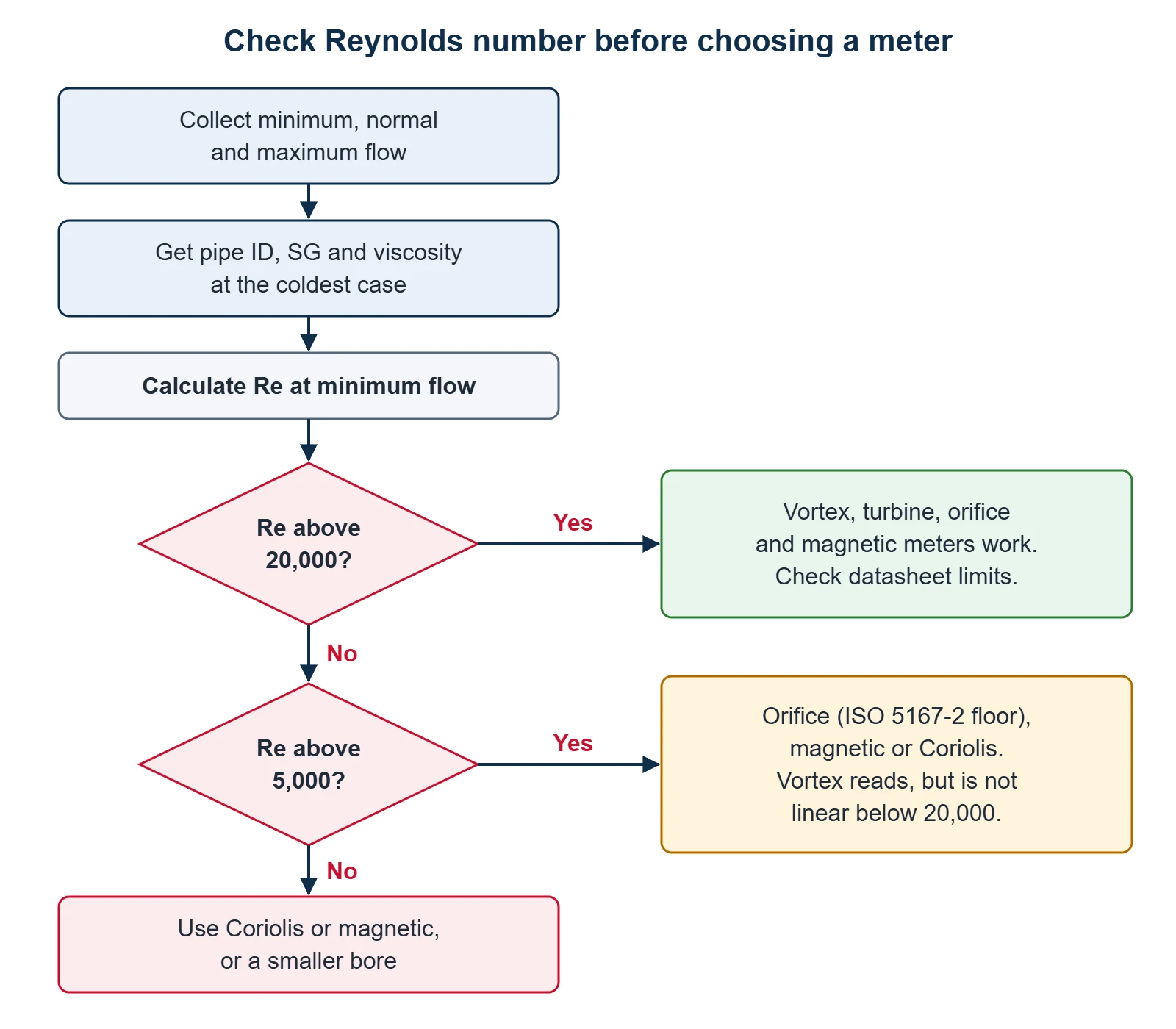
Here is a quick sizing check with the 3 inch water line from the example. At Re = 20,000 the flow is 20,000 × 3.068 × 1.0 / (3160 × 1.0) = 19.4 gpm (4.4 m3/h), so a vortex meter in that line holds its linear accuracy only above about 19.4 gpm.
Browse the Kleev flowmeter range with that minimum in hand. Size any orifice plate for DP flow on the same basis and pair it with a suitable flow transmitter.
How does temperature change the Reynolds number?
Temperature changes viscosity, and viscosity sits in the bottom of the Reynolds number formula. Hotter liquids usually get thinner, so Re goes up as the line warms.
Engineering ToolBox lists water viscosity at 1.0016 cP at 68 °F (20 °C) and 0.466 cP at 140 °F (60 °C). That is why the same 150 gpm in our example moves from about 154,500 to about 331,500.
Oils swing much harder than water, so a heavy oil line that is turbulent on a hot afternoon can slip toward laminar on a cold start. Always run the Reynolds number at the coldest operating case you expect.
Gas behaves the other way round in some cases, because gas viscosity rises with temperature while density falls. Check both terms from a property table rather than assuming.
What problems does a low Reynolds number cause in the field?
A low Reynolds number shows up as readings that drift, drop out at low flow or disagree with a second meter. The table lists the cases we meet most often and what to check.
| Symptom | Likely cause | Fix |
|---|---|---|
| Vortex meter reads zero at low flow | Reynolds number below the meter’s minimum measurable value | Recalculate Re at minimum flow, consider a reduced bore meter |
| Orifice flow reads high on cold mornings | Viscosity up, Re down, coefficient shifted | Check Re at the coldest case and use a compensated calculation |
| Turbine meter total drifts with product change | New product viscosity moves the meter factor | Use a calibration curve against Re or Hz per cSt |
| Two meters in series disagree | One sits in transitional flow, 2,300 to 4,000 | Move to a technology with less sensitivity to Re |
| Readings jump around steadily | Flow cycling between laminar and turbulent | Raise velocity with a smaller line or pick a mass meter |
Before you blame the transmitter, write down Re at the time of the fault. Many “bad meter” calls turn out to be a process running outside the meter’s Reynolds range.
Leaky impulse lines also mimic these problems on DP meters, so check the instrument valve manifold and tube fittings for leaks as part of the same visit.
Pros and cons of Reynolds number checks
A Reynolds number check is quick and cheap, but it is only as good as the viscosity value behind it. Here is the balance we see on real projects.
Pros
- One number tells you the flow regime
- Works for liquids, gases and steam
- Lets you compare meters on a common basis
- Needs only data you already have on the datasheet
Cons
- Viscosity data at temperature is often missing
- Limits like 2,300 and 4,000 are ranges, not hard lines
- Ignores swirl and poor straight run upstream
- Non-Newtonian fluids need special handling
Myth vs fact about Reynolds number
A few common beliefs about the Reynolds number cause real sizing errors. These are the ones we hear on site most often.
Water is always turbulent, so the Reynolds number never matters.
Water in large mains is usually turbulent, but low flow in a big pipe can still drop below a vortex meter’s 20,000 linear limit.
You can use the nominal pipe size in the formula.
Use the true inside diameter, such as 3.068 inches (77.9 mm) for 3 inch Schedule 40.
Flow switches from laminar to turbulent at exactly 2,300.
The change happens over a band, often quoted as 2,300 to 4,000.
A high Reynolds number fixes a bad installation.
Swirl from elbows and valves still distorts the profile, so straight run rules still apply.
Industrial Applications of Reynolds number
Plant engineers use the Reynolds number every time they size a flow meter, a control valve or a pipe run. These are typical cases by industry.
Refinery
Crude, residue and lube oil lines can run at a low Reynolds number, especially at startup temperatures. Engineers check the coldest case before choosing between DP, vortex and Coriolis meters.
Water and wastewater plant
Treated water mains usually run at a high Reynolds number, which suits magnetic and DP meters. Night time low flow is the case to check, because it can fall below a vortex or orifice limit.
HVAC
Chilled and hot water loops normally run turbulent, but glycol mixes raise viscosity and lower Re. Recheck meters on any loop that changes from water to a glycol blend.
Chemical plant
Resins, syrups and polymer solutions often sit in the laminar range at a low Reynolds number. For these, mass meters are a common choice because their reading depends little on the profile.
Control valve sizing uses the same idea. ISA 75 sizing equations include a Reynolds number factor for viscous liquids, and our sister blog covers valve flow coefficient Cv and Kv in more depth.
Frequently asked questions
What is a good Reynolds number for a vortex flow meter?
Aim for a Reynolds number above 20,000 at minimum flow for liquids, or above 15,000 for gas and steam, based on Emerson’s Rosemount 8800 note. The meter may still read down to about 5,000, but it will not meet its linear accuracy there, so size the bore to stay above the linear limit.
Is Reynolds number really dimensionless or does it have units?
It is truly dimensionless, because the units of density, velocity, length and viscosity cancel out. That is why the same Reynolds number means the same flow regime in a small lab tube and a large plant pipe, as long as you keep the units consistent when you calculate it.
Why is 2,300 used as the laminar limit in pipe flow?
Laboratory pipe tests show smooth layered flow is stable below about 2,300, while disturbances grow and mix the flow above it. Real pipes with rough walls, vibration and fittings often trip earlier, so engineers treat 2,300 to 4,000 as a transition band rather than a single switch point.
Which pipe diameter should I use in the Reynolds formula?
Use the actual inside diameter of the pipe or the meter bore, not the nominal size. For 3 inch Schedule 40 that means 3.068 inches (77.9 mm), while Schedule 80 has a smaller ID and gives a slightly higher result for the same flow rate.
How does viscosity affect turbine flow meter readings at low flow?
Higher viscosity lowers Re, which changes the drag on the rotor and shifts the meter factor. NIST plots turbine calibration data against Reynolds number or Roshko number so curves from fluids of different viscosity line up, which lets you correct readings when the product changes.
Can I calculate Reynolds number from gpm and pipe size only?
Not quite, because you also need specific gravity and viscosity at operating temperature. With those four values the field formula Re = 3160 × Q × SG / (d × μ) gives the answer directly, with Q in gpm, d in inches and viscosity in centipoise.