
What Is a Needle Valve? Working, Types, Cv & Selection
Table of Contents
- What is a needle valve used for?
- How does a needle valve work?
- What are the parts of a needle valve?
- Can a needle valve be used for isolation?
- What are the different types of needle valve?
- What pressure can a needle valve handle?
- How do you calculate flow through a needle valve?
- Solved example: needle valve on a water sample line
- Needle valve liquid flow calculator
- How do you install a needle valve correctly?
- How do you maintain a needle valve?
- Why is my needle valve leaking?
- Needle valve vs ball valve: what is the difference?
- Pros and cons of a needle valve
- Pros
- Cons
- Myth vs fact about the needle valve
- Industrial applications of the needle valve
- Refinery
- Water and wastewater plant
- HVAC
- Chemical plant
- Frequently asked questions
- Can a needle valve be used as a shutoff valve?
- Which way do you turn a needle valve to open it?
- Is a needle valve directional or can flow go either way?
- How do you stop a packing leak on an instrument valve?
- What does Cv mean on a small instrument valve datasheet?
A needle valve is a small, fine-threaded valve that lets you set a low flow with precision or shut off a pressure gauge, transmitter or sample point. If you install, specify or maintain instrument impulse lines, the needle valve is the part you will turn more than any other.
What is a needle valve used for?
A needle valve is a manual valve with a long, tapered stem tip that seats in a small orifice, so many turns of the handle give a very small change in flow area. Plants use a needle valve to meter low flows of gas or liquid, to isolate and vent pressure gauges and transmitters, and to set purge, sample and injection flows that must hold steady for a long time.
How does a needle valve work?
A needle valve works by moving a tapered tip in and out of a matching seat on a fine screw thread. As you turn the handle counterclockwise, the tip lifts and opens a narrow ring-shaped gap that grows slowly with each turn.
The Wikipedia entry on this valve type describes a vernier effect: a long axial travel of the stem gives a very small radial change at the seat. That is why the needle valve meters flow so finely, and also why it takes several turns to go from closed to fully open.
WIKA’s operating instructions for its instrument valves state about 4 turns from open to closed, clockwise to close. That gives far better resolution near the closed end than a quarter turn valve.
What are the parts of a needle valve?
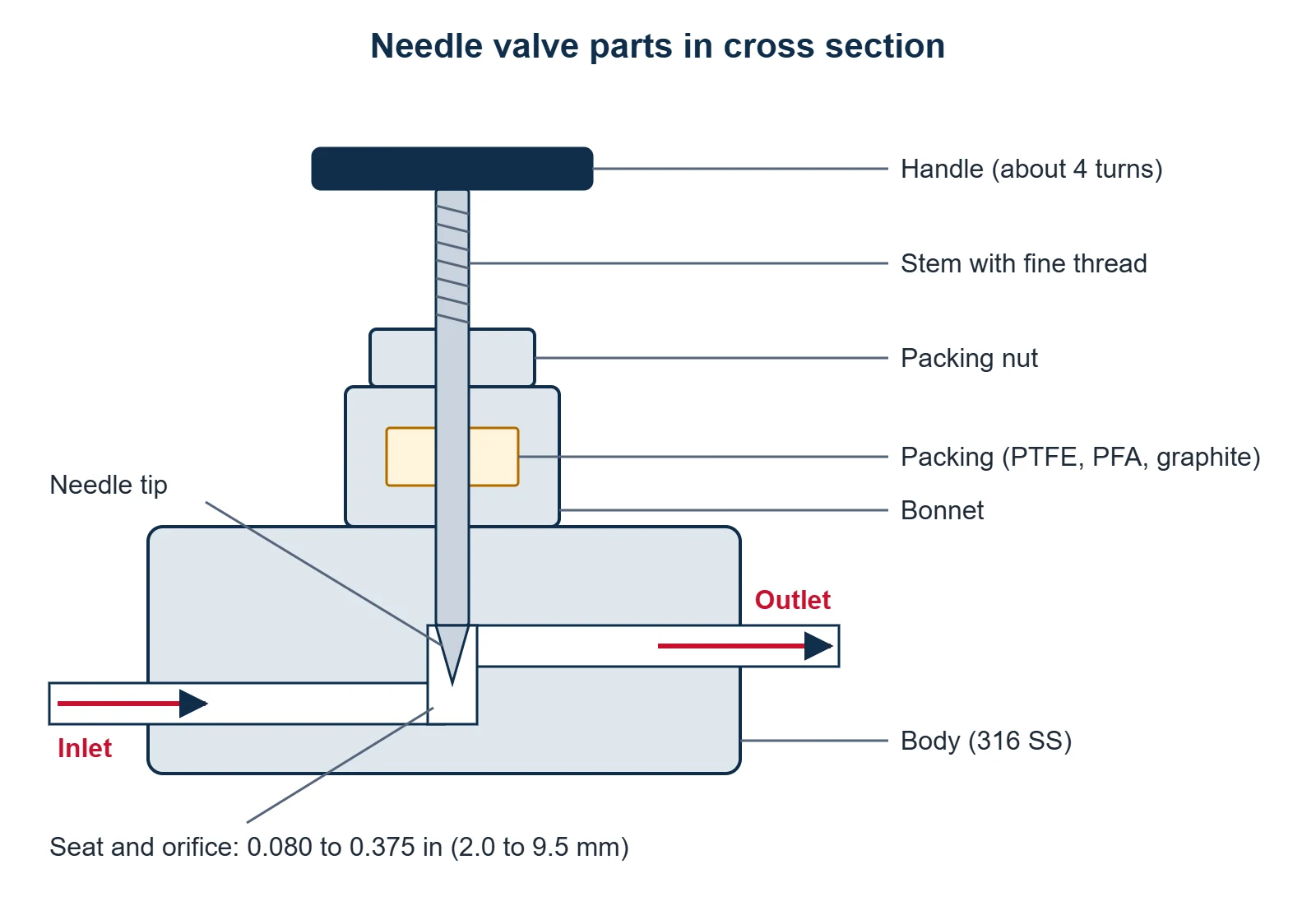
A needle valve has six main parts: body, stem, needle tip, seat, packing and bonnet with a packing nut. The handle sits on top of the stem and drives it through a fine thread in the bonnet.
| Part | What it does | Typical material or option |
|---|---|---|
| Body | Holds the inlet, outlet and seat, carries line pressure | 316 stainless steel bar stock, also alloy 400, alloy C-276 |
| Needle tip | Shapes the flow area and seals on the seat | Vee, regulating or soft-seat PCTFE tip |
| Seat and orifice | Sets the maximum flow and shutoff point | 0.080 to 0.375 in (2.0 to 9.5 mm) bore |
| Packing | Seals the stem against leakage to air | PTFE, PFA, PEEK or graphite |
| Bonnet and packing nut | Guides the stem and compresses the packing | Integral (threaded in) or union style |
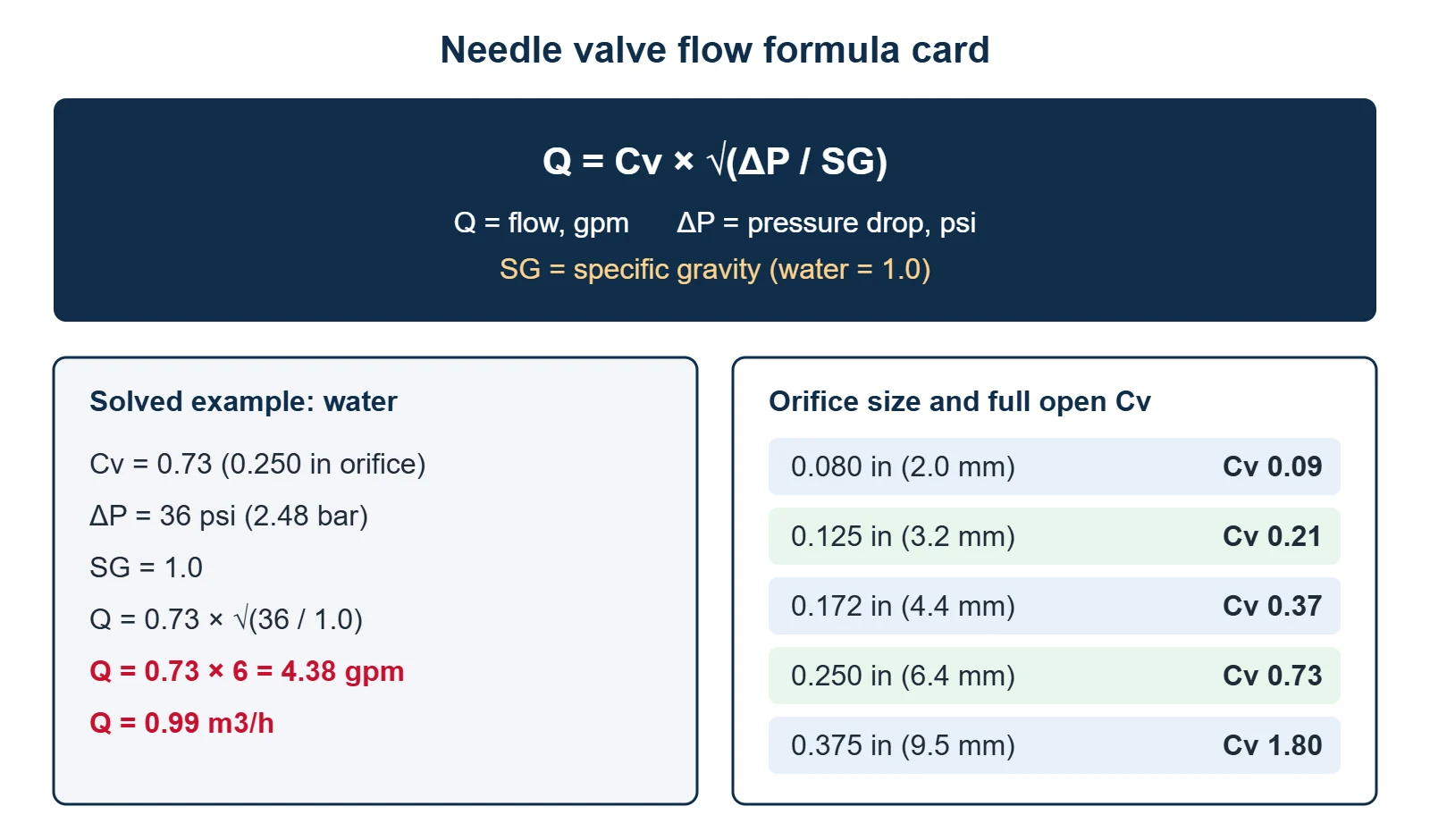
The orifice sizes come from Swagelok’s integral bonnet catalog, which lists full open Cv from 0.09 at 0.080 in (2.0 mm) to 1.80 at 0.375 in (9.5 mm). A vee tip shuts off and throttles, a regulating tip gives finer control, and a soft-seat PCTFE tip seals gas tightly but is limited to 200 °F (93 °C).
Can a needle valve be used for isolation?
Yes, an instrument needle valve is the standard way to isolate a pressure gauge, switch or transmitter from the process. It is not meant for frequent full-bore shutoff on large lines, but on a 1/2 in (12.7 mm) impulse line it closes tight with hand torque.
A typical hookup puts a root valve at the process tap and a block and bleed valve under the instrument. The bleed port vents trapped pressure before you remove the gauge.
You can find matching instrument valves and manifolds for transmitter hookups, and gauge accessories such as siphons and snubbers that install with the valve. Most hookups also need a pressure gauge sized to the range and a set of compression instrument fittings.
What are the different types of needle valve?
The common needle valve types are straight, angle, integral bonnet, union bonnet and metering. They differ in flow path, how the bonnet is held to the body, and how fine the control is.
| Needle valve type | Key feature | Where you use it |
|---|---|---|
| Straight pattern | Inlet and outlet in line | Gauge isolation, inline impulse lines |
| Angle pattern | 90 degree turn through the body | Tight spaces, saves an elbow fitting |
| Integral bonnet | Bonnet threaded into the body, cannot be removed by mistake | General instrument isolation up to 6,000 psig (413 bar) |
| Union bonnet | Bonnet held by a union nut, easy to service | Severe service and higher pressure, up to 10,000 psig (689 bar) |
| Metering valve | Long taper, vernier handle, low Cv | Analyzer sample flow, purge gas, lab work |
A metering valve is built for flow setting, not shutoff, so pair it with a separate isolation valve. Block and bleed versions combine isolation and vent in one body.
What pressure can a needle valve handle?
A stainless steel instrument needle valve is usually rated 6,000 psig (413 bar) at room temperature, with high pressure versions at 10,000 psig (689 bar). The rating drops as temperature rises and also depends on the packing.
The Swagelok integral bonnet catalog rates 316 SS bodies at 6,000 psig (413 bar) from minus 65 to 100 °F (minus 53 to 37 °C) under ASME Class 2500. Its standard PFA packing runs to 450 °F (232 °C) and PEEK packing to 600 °F (315 °C).
| Needle valve rating point | Pressure | Source |
|---|---|---|
| Integral bonnet, 316 SS, up to 100 °F (37 °C) | 6,000 psig (413 bar) | Swagelok MS-01-164 |
| Union bonnet N series, 316 SS, at 600 °F (315 °C) | 3,760 psig (259 bar) | Swagelok MS-01-168 |
| Union bonnet HN series, up to 100 °F (37 °C) | 10,000 psig (689 bar) | Swagelok MS-01-168 |
| PTFE packing, up to 68 °F (20 °C) | 10,000 psi (690 bar) | WIKA IV series instructions |
Always check the derated value at your maximum temperature, not the headline figure. Graphite packing is the usual choice above 600 °F (315 °C).
How do you calculate flow through a needle valve?
Use the liquid flow equation Q = Cv × √(ΔP / SG), where Cv is the valve flow coefficient at the opening you are using. For a needle valve the catalog Cv is the full open value, so a partly open valve passes less.
Q = Cv × √(ΔP / SG)
Q = liquid flow, gpm; ΔP = pressure drop across the valve, psi
SG = specific gravity, water at 60 °F = 1.0
Kv = 0.865 × Cv (Kv in m3/h at 1 bar drop)
Engineering ToolBox defines Cv as the water flow in gpm at 60 °F with a 1 psi pressure drop. Our sister blog covers valve flow coefficient Cv and Kv in more depth.
Solved example: needle valve on a water sample line
Given: a needle valve with a 0.250 in (6.4 mm) orifice and full open Cv 0.73 passes water, SG 1.0, with a pressure drop of 36 psi (2.48 bar).
- ΔP / SG = 36 / 1.0 = 36
- √36 = 6
- Q = 0.73 × 6 = 4.38 gpm
- In SI: 4.38 × 0.2271 = 0.99 m3/h (16.6 L/min)
So 4.38 gpm (0.99 m3/h) is the most this needle valve can pass at that drop. A light oil with SG 0.85 at the same 36 psi (2.48 bar) gives 0.73 × √(36 / 0.85) = 4.75 gpm (1.08 m3/h), because a lighter liquid flows faster for the same drop.
Needle valve liquid flow calculator
Use full open Cv to find the upper limit. The equation is for liquids only; gas needs a compressible flow equation.
How do you install a needle valve correctly?
Mount the needle valve with its flow arrow pointing from the process toward the instrument, and support it so the tubing does not carry its weight. Tighten threaded ends only on the wrench flats of the body.
WIKA says to operate the handle by hand only and close to a hand-tight stop. Swagelok says the same: use only the torque needed for positive shutoff.
- Blow out the impulse line before fitting the needle valve, so weld slag and tape do not reach the seat.
- Use a bleed port or block and bleed needle valve where you will remove the instrument under pressure.
- Pick packing for the hottest case: PFA to 450 °F (232 °C), PEEK to 600 °F (315 °C), graphite above that.
How do you maintain a needle valve?
Most needle valve maintenance is a periodic packing check and a tightening of the packing nut. WIKA recommends an inspection interval of 3 months or less, covering a function test and a leak check at the bonnet and both ends.
To adjust packing on WIKA’s design, loosen the lock nut, turn the gland nut about 1/6 turn clockwise and lock it again. Overtightening the gland raises the handle torque, so go in small steps.
Swagelok notes that idle valves may need higher torque on the first turn, so cycle them during routine checks.
Why is my needle valve leaking?
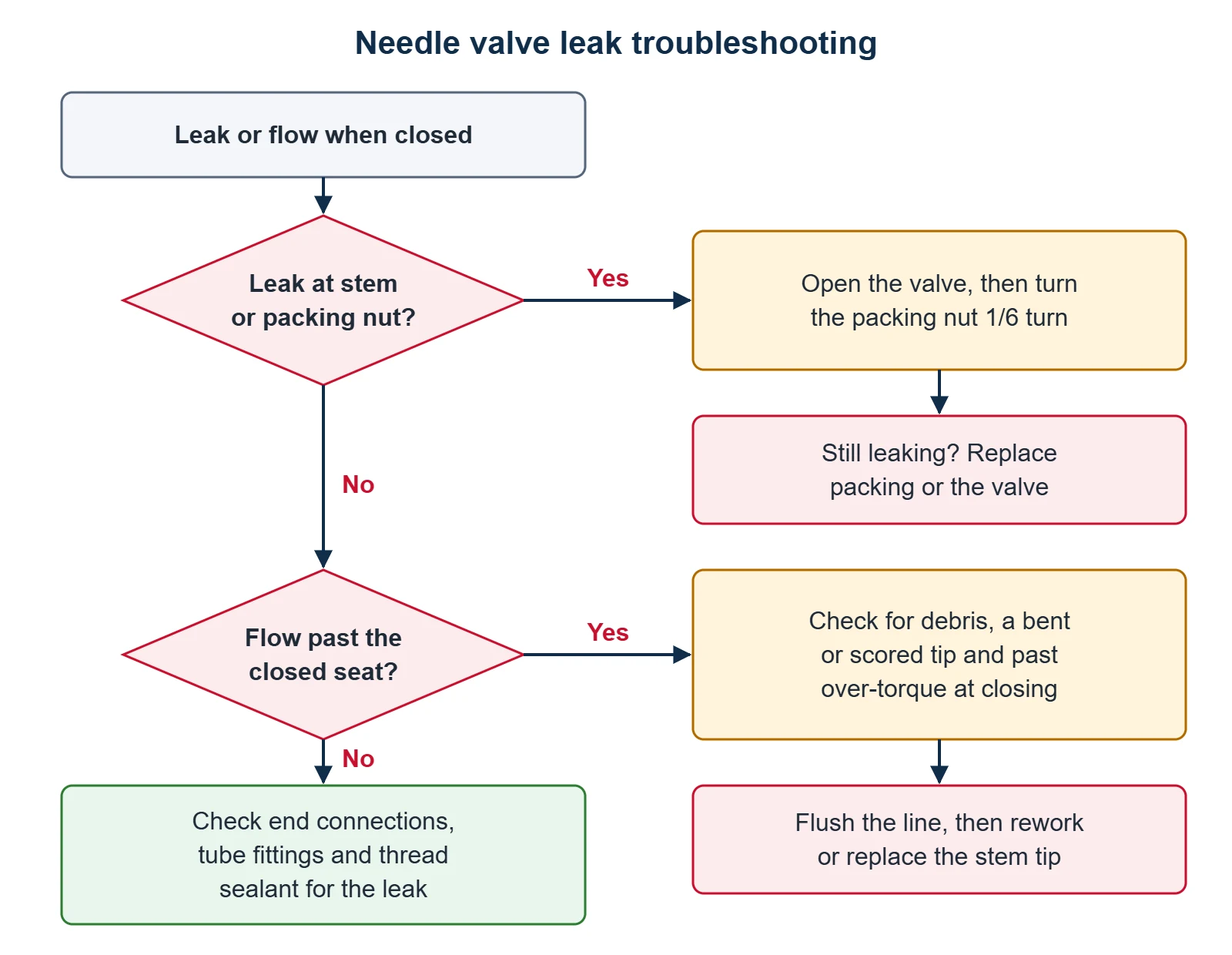
A needle valve leaks either out through the packing or through the closed seat. Stem leaks are usually loose or worn packing, while seat leaks come from debris, a damaged tip or a seat pressed out of shape by too much force.
| Symptom | Likely cause | Fix |
|---|---|---|
| Weeping at the stem | Packing relaxed after heat cycles | Tighten the packing nut about 1/6 turn and recheck |
| Gauge still reads with valve shut | Debris on the seat or a scored needle tip | Flush the line, then rework or replace the stem tip |
| Handle very stiff | Packing overtightened or valve not cycled for months | Back off the nut slightly, cycle the valve a few times |
| Handle spins with no change in flow | Stem thread stripped by wrench torque | Replace the needle valve, train staff on hand-only closing |
| Leak at the end connection | Thread sealant missing or fitting not made up | Remake the NPT joint or the tube fitting |
The flowchart below gives the order we follow in the field, easiest check first.
Needle valve vs ball valve: what is the difference?
A needle valve gives fine, multi-turn control of small flows, while a ball valve gives fast quarter turn open or close with a full bore. Choose the needle valve for metering and instrument isolation, and the ball valve when you need quick shutoff or low pressure drop.
| Feature | Needle valve | Ball valve |
|---|---|---|
| Operation | Multi-turn, about 4 turns | Quarter turn |
| Flow control | Fine throttling and metering | Poor, mainly open or closed |
| Typical Cv in 1/4 in (6.35 mm) size | 0.09 to 0.73 | Much higher, full or reduced bore |
| Best use | Gauges, transmitters, sample and purge lines | Drains, vents, fast isolation |
For larger process lines, look at the range of industrial valves, including ball valves for quick shutoff and globe valves for throttling bigger flows. Our overview of industrial valves and fittings shows where each family fits.
Pros and cons of a needle valve
A needle valve is cheap, compact and precise, but it passes little flow and is easy to damage with force.
Pros
- Very fine flow adjustment over several turns
- Tight shutoff with hand torque
- Ratings up to 10,000 psig (689 bar) in stainless steel
- Small size for gauge and transmitter hookups
- Adjustable packing extends service life
Cons
- Low Cv, so high pressure drop
- Slow to open and close
- Fine stem thread strips under wrench torque
- Small orifice clogs on dirty or viscous fluids
- Open or closed position is not obvious
Myth vs fact about the needle valve
Several common beliefs about the needle valve lead to damaged seats and wrong sizing.
Tighter is better when you close a needle valve.
Both WIKA and Swagelok say to close only to hand-tight shutoff. Extra force deforms the seat and causes the very leak you were trying to stop.
The catalog Cv is the flow at any handle position.
The listed Cv is the full open value. A throttled needle valve passes less, so use the maker’s flow curve for partial openings.
Any packing works at any temperature.
PFA packing is limited to 450 °F (232 °C) and PEEK to 600 °F (315 °C) in Swagelok’s catalog. Hotter service needs graphite packing.
A metering valve can replace an isolation valve.
A metering needle valve is built for flow setting and may not give positive shutoff. Fit a separate isolation valve upstream.
Industrial applications of the needle valve
You will find the needle valve wherever an instrument meets the process or a small flow must be held steady.
Refinery
Every pressure gauge and transmitter on crude, hydrotreater and steam lines sits behind a root valve and an isolation needle valve. Union bonnet valves with graphite packing handle the hot services.
Water and wastewater plant
A needle valve sets the steady sample flow to chlorine, pH and turbidity analyzers. Gauge valves on pump headers let crews swap gauges without draining the line.
HVAC
Chilled and hot water systems use gauge isolation valves at pumps, chillers and coils. Small needle valves also serve as air bleeds on high points.
Chemical plant
A metering needle valve with a rotameter sets nitrogen purge to DP transmitter impulse lines and to analyzer housings. It also trims small chemical injection flows.
Differential pressure hookups often use two needle valve blocks or a manifold, and the same isolation logic applies to differential pressure gauges. The formula card below is a quick sizing reference.
Frequently asked questions
Can a needle valve be used as a shutoff valve?
Yes, an instrument needle valve shuts off tightly on small lines when closed by hand to its stop. It is a slow multi-turn valve, so it is not the right pick for frequent or emergency shutoff on larger lines, where a ball valve is quicker. Metering versions may not seal positively at all.
Which way do you turn a needle valve to open it?
Turn the handle counterclockwise to open and clockwise to close, the same as most threaded stem valves. WIKA’s instructions state about 4 turns between open and closed on its instrument valves. Close only to a hand-tight stop, and never use a wrench or a cheater bar on the handle.
Is a needle valve directional or can flow go either way?
Many instrument valves are marked with a flow arrow, and WIKA’s instructions require it to point from the process connection toward the instrument. Installing it backwards can load the packing with line pressure when the valve is closed. Always follow the arrow or the maker’s datasheet for the model you install.
How do you stop a packing leak on an instrument valve?
Open the valve slightly, then tighten the packing nut in small steps, about 1/6 turn at a time as WIKA advises, and check again. If the stem still weeps, the packing is worn: replace it or swap the whole valve. Overtightening only raises handle torque and speeds wear.
What does Cv mean on a small instrument valve datasheet?
Cv is the flow of 60 °F water in gpm that passes with a 1 psi drop across the valve when it is fully open. Integral bonnet instrument valves in Swagelok’s catalog range from Cv 0.09 to 1.80, depending on orifice size. Use Q = Cv × √(ΔP / SG) to estimate liquid flow.