
Bourdon Tube Pressure Gauge: Working Principle, Parts and Selection
Table of Contents
- How does a bourdon tube pressure gauge work?
- What is the working principle of a bourdon tube pressure gauge?
- What are the main parts of a bourdon tube pressure gauge?
- How does the movement magnify tube motion?
- What are the types of Bourdon tube?
- C-type tube
- Helical tube
- Spiral tube
- What is the range of a bourdon tube pressure gauge?
- What material is used for a Bourdon tube?
- How do you select the range of a bourdon tube pressure gauge?
- Bourdon tube pressure gauge range: a solved example
- Solved example
- Bourdon tube pressure gauge range calculator
- Gauge range calculator
- How do pulsation and overpressure affect a Bourdon tube?
- How do you troubleshoot a bourdon tube pressure gauge?
- Pros and cons of a bourdon tube pressure gauge
- Pros
- Cons
- Myth vs fact about the bourdon tube pressure gauge
- Industrial applications of the bourdon tube pressure gauge
- Refinery
- Water and wastewater plant
- HVAC
- Chemical plant
- Frequently asked questions
- Why does a bourdon tube pressure gauge use an oval cross section?
- Can a bourdon tube pressure gauge measure vacuum as well as pressure?
- What percent of full scale should normal operating pressure be on a gauge?
- What is the difference between C-type, helical and spiral Bourdon tubes?
- When should I use stainless steel instead of a brass Bourdon tube?
A bourdon tube pressure gauge turns process pressure into pointer movement with a bent metal tube, a few gears and a spring. If you install, specify or buy these gauges, the sections below cover how the mechanism works and how to pick the right tube, material and range.
The Wikipedia entry on pressure measurement notes that Eugène Bourdon patented his gauge in France in 1849. The same basic tube still sits inside most dial gauges on US plant floors.
How does a bourdon tube pressure gauge work?
A bourdon tube pressure gauge works because a curved tube with an oval cross section tries to become round when pressure fills it, so the curve opens and the sealed tip moves. A link, sector gear and pinion magnify that small tip travel into pointer rotation. Pick a range so normal pressure sits between 25% and 75% of the scale.
What is the working principle of a bourdon tube pressure gauge?
The working principle of a bourdon tube pressure gauge is elastic deformation: pressure pushes a flattened, curved tube toward a round cross section, and that straightens the curve. Tip movement follows pressure, so a linkage can turn it into a readable scale.
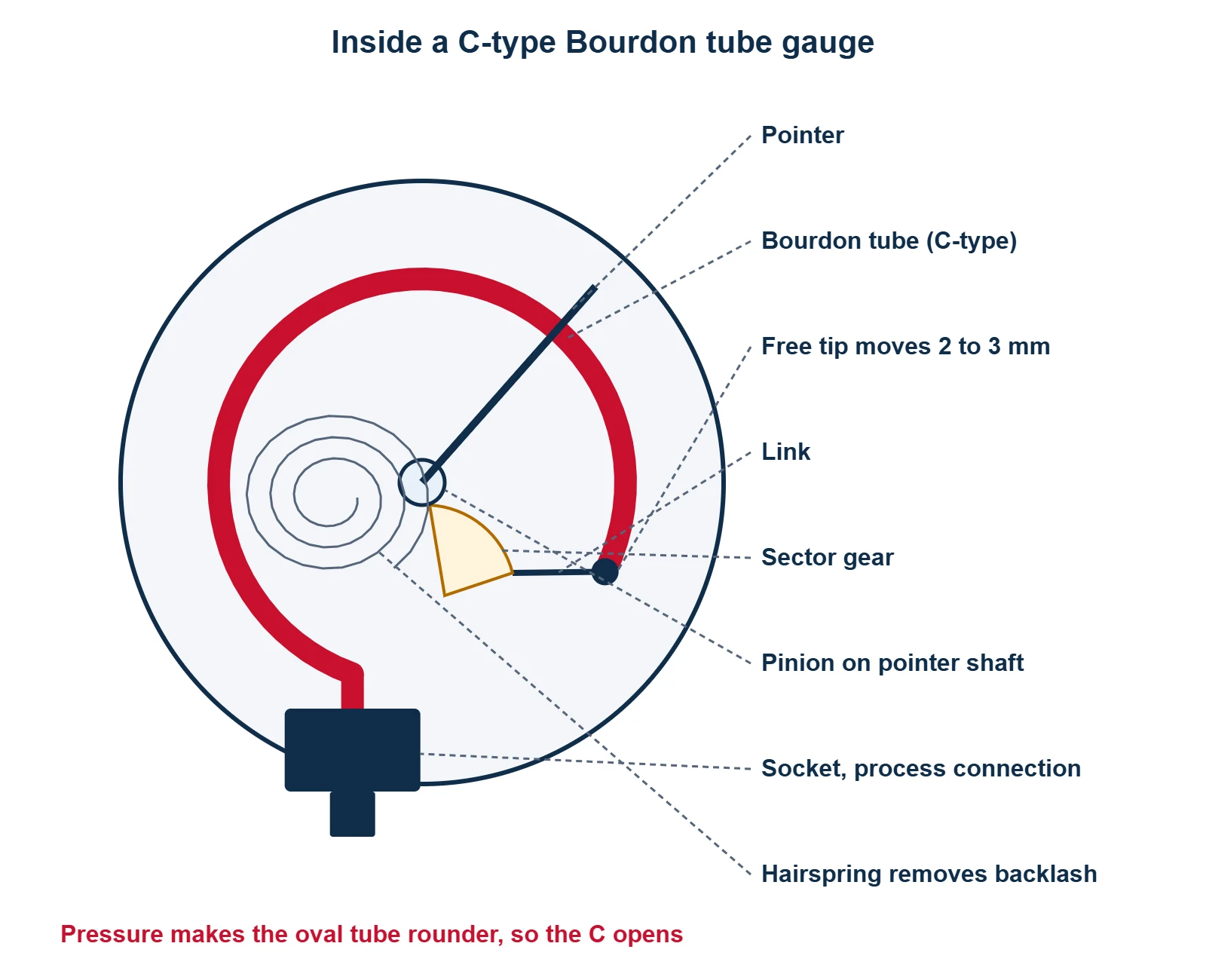
WIKA’s operating principle page explains that hoop stresses in the rounding tube increase the radius of the bend. The free end moves only about 0.08 to 0.12 inches (2 to 3 mm), so everything after the tube in a bourdon tube pressure gauge exists to magnify that motion.
Think of a party horn that straightens when you blow into it. A bourdon tube pressure gauge does the same with metal stiff enough to spring back when pressure falls.
The outside of the tube sees the atmosphere inside the case, so a bourdon tube pressure gauge reads gauge pressure. Our post on psig versus psia explains the difference.
What are the main parts of a bourdon tube pressure gauge?
The main parts of a bourdon tube pressure gauge are the socket, tube, link, sector gear, pinion, hairspring, pointer, dial and case. Each part either holds pressure or passes motion to the pointer.
- Socket: the threaded block that holds the fixed, open end of the tube.
- Bourdon tube: the sensing element, formed as a C, a helix or a spiral.
- Tip and link: the sealed tip connects to the movement through an adjustable link.
- Sector and pinion: the sector gear swings on a pivot and drives the pinion on the pointer shaft.
- Hairspring: a fine spiral spring that keeps the gear teeth loaded one way.
- Dial, pointer and case: the scale, the needle and the housing, dry or liquid filled.
Wikipedia notes that the hairspring preloads the gear train to remove gear lash and hysteresis. You set calibration on a bourdon tube pressure gauge through the dial position, the pointer position and the link length.
How does the movement magnify tube motion?
The movement is a lever and gear amplifier. The link turns tip travel into sector rotation, and the sector to pinion gear ratio multiplies it at the pointer.
The control.com textbook describes it: as the C tube straightens, the link pulls the sector counterclockwise and the pinion spins the pointer clockwise. Ashcroft notes that ASME B40.100 dials typically sweep 270 degrees, so a few millimeters of tip travel becomes three quarters of a turn.
That is why a bourdon tube pressure gauge can read wrong with a perfect tube. A bent link or worn pinion shows up as zero or span error.
What are the types of Bourdon tube?
The three types are the C-type, helical and spiral tube. All work the same way, but the extra coils of a helix or spiral give more tip travel.
C-type tube
The C-type is the single bend found in most dial gauges. WIKA lists C-shaped tubes for pressures up to about 870 psi (60 bar).
Helical tube
A helical tube is wound into several coils, each adding its own unwinding. Brannan’s knowledge base notes that high pressure helical tubes may have up to about twenty coils, and low pressure versions two or three.
Spiral tube
A spiral tube is wound flat around a common center. It uncoils further than a C, so a spiral bourdon tube pressure gauge needs little or no mechanical amplification.
WIKA states that helical and spiral tubes reach up to about 101,500 psi (7,000 bar), depending on geometry, material and wall thickness. Thick walls suit high ranges and thin walls suit low ranges.
What is the range of a bourdon tube pressure gauge?
WIKA’s product data gives a bourdon tube pressure gauge range of about 8.7 to 101,500 psi (0.6 to 7,000 bar). Below roughly 8.7 psi (0.6 bar), a capsule or diaphragm element is the better choice.
For inches of water column, WIKA’s selection guide points you to capsule gauges, and our post on the main pressure gauge types covers those elements. An engineering measurement course page notes that a vacuum bourdon tube pressure gauge tops out near 30 inHg (760 mm Hg), while compound gauges read vacuum and pressure on one dial.
What material is used for a Bourdon tube?
Tubes are made from copper alloys, stainless steel or nickel copper alloys such as Monel. The fluid, temperature and range decide which one fits your bourdon tube pressure gauge.
| Tube material | Typical use | Limit to watch |
|---|---|---|
| Copper alloy | Water, air, non aggressive media | WIKA: brass solder breaks down at 140 °F (60 °C) |
| 316 stainless steel | Corrosive, hot or high range service | WIKA: up to 392 °F (200 °C) |
| Monel | Sour gas, ammonia, creosote | Higher cost |
| Any tube with diaphragm seal | Slurries, viscous or crystallizing media | Fill fluid temperature |
WIKA’s copper alloy line is not suitable for media that attack copper. If the fluid can plug the tube, add a seal as our post on why diaphragm seals are used explains.
How do you select the range of a bourdon tube pressure gauge?
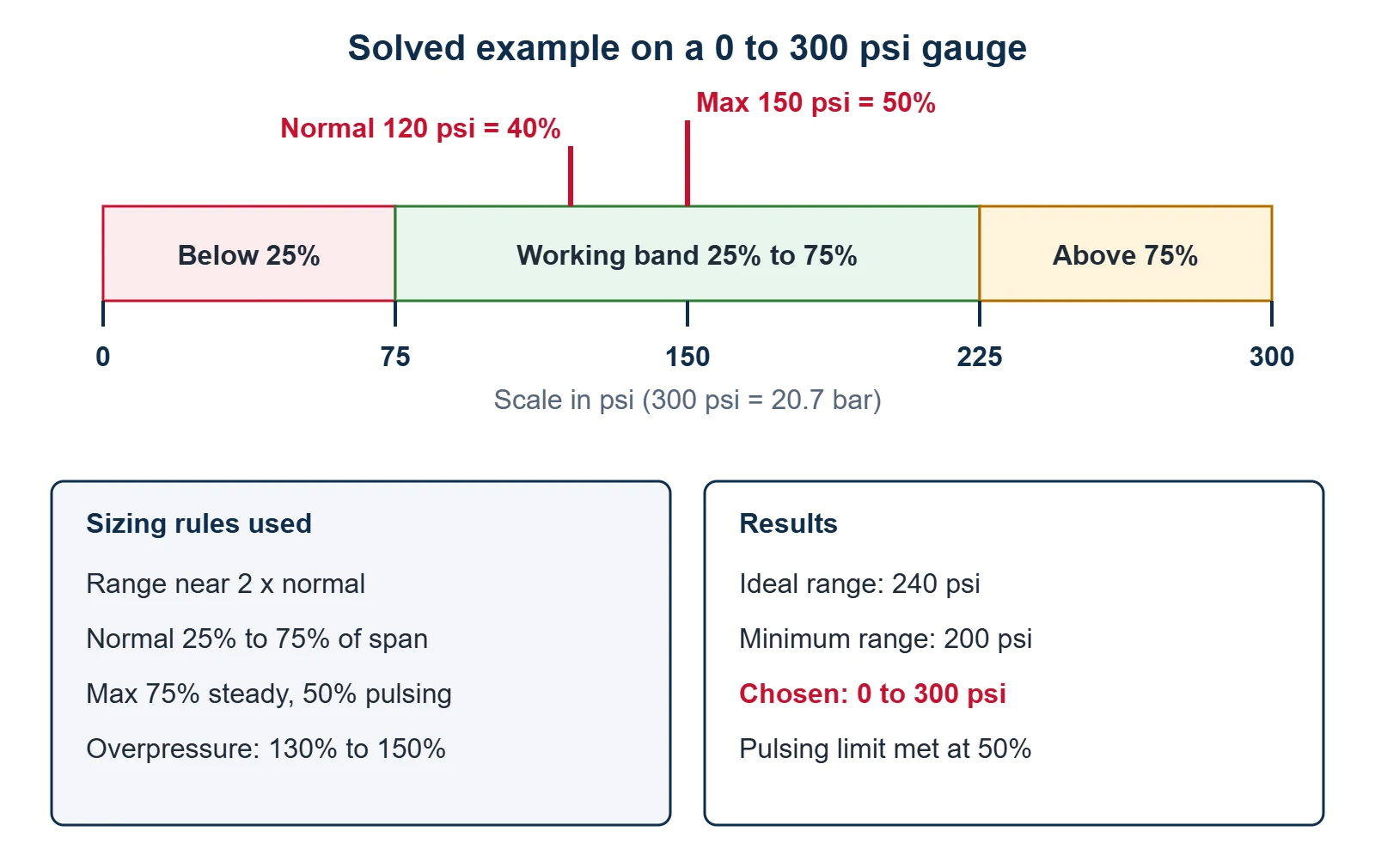
Choose a bourdon tube pressure gauge range of about twice the normal operating pressure, so the pointer sits near mid scale. Keep normal pressure between 25% and 75% of scale and the maximum at or below 75% for steady service.
Ashcroft’s range selection article, citing ASME B40.100, gives the 25% to 75% band and the twice operating pressure rule. It adds that pulsating service should keep maximum pressure at or below 50% of full scale.
The middle half of the scale is where a bourdon tube pressure gauge is happiest. Near zero the tube barely flexes, and near full scale every cycle works the metal hard.
Bourdon tube pressure gauge range: a solved example
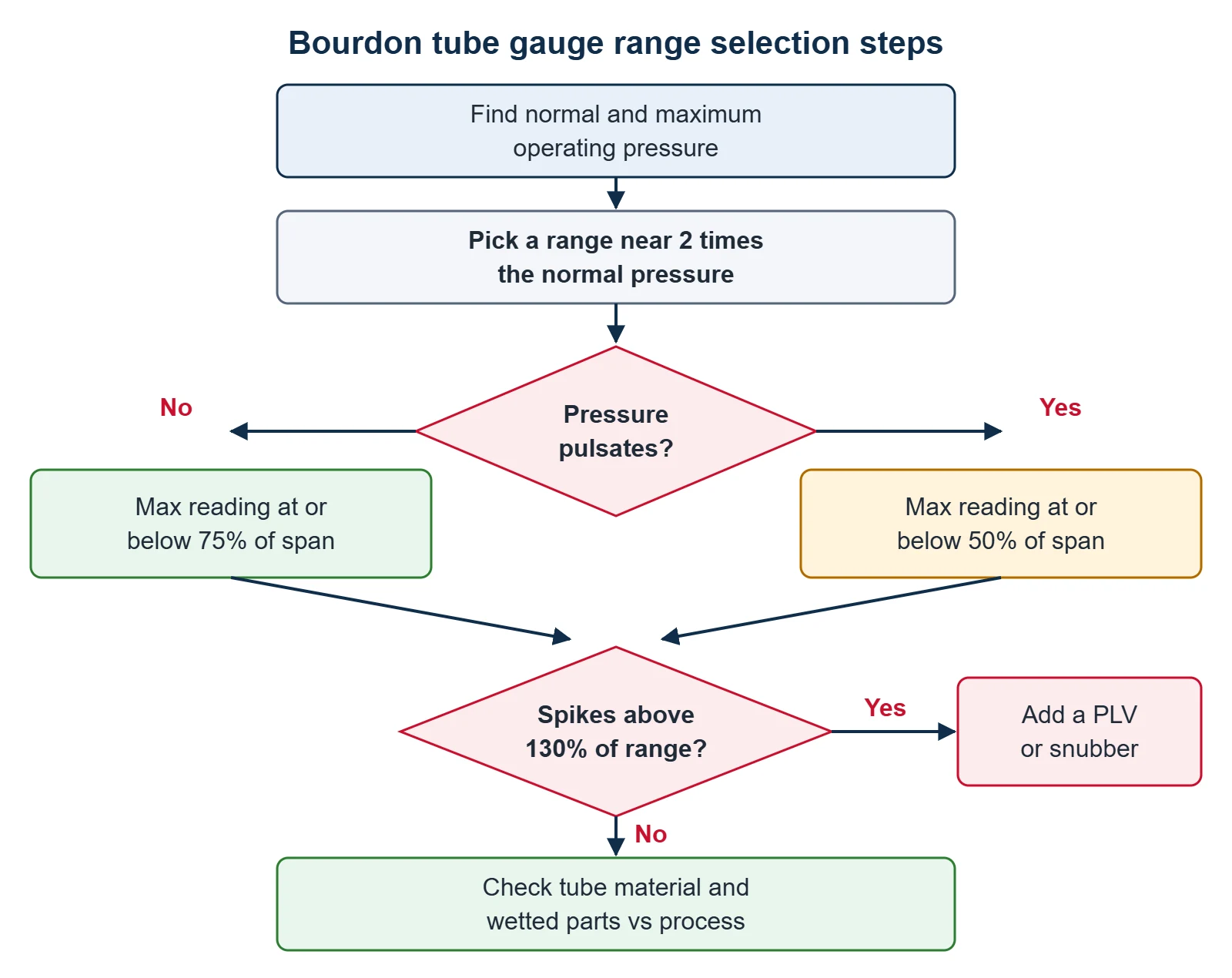
For a pump at 120 psi (8.27 bar) normal and 150 psi (10.34 bar) maximum, a 0 to 300 psi (0 to 20.7 bar) bourdon tube pressure gauge is the right choice.
Solved example
Given: normal 120 psi (8.27 bar), maximum 150 psi (10.34 bar), steady service, candidate bourdon tube pressure gauge range 0 to 300 psi (0 to 20.7 bar).
- Ideal range = 2 × 120 = 240 psi (16.5 bar). Nearby standard ranges are 0 to 200 and 0 to 300 psi.
- Minimum steady range = 150 / 0.75 = 200 psi (13.8 bar). A 0 to 200 psi dial leaves no margin.
- Normal on 300 psi = 120 / 300 = 40% of span, inside the 25% to 75% band.
- Maximum on 300 psi = 150 / 300 = 50% of span, which also meets the 50% pulsating limit.
- Result: a 0 to 300 psi (0 to 20.7 bar) bourdon tube pressure gauge.
If the pump is later replaced by a reciprocating unit, the minimum range becomes 150 / 0.5 = 300 psi. The same bourdon tube pressure gauge still fits.
Bourdon tube pressure gauge range calculator
Enter normal pressure, maximum pressure and the range you are considering. The bourdon tube pressure gauge calculator returns percent of span and the smallest range that meets the 75% steady or 50% pulsating limit.
Gauge range calculator
How do pulsation and overpressure affect a Bourdon tube?
Pulsation flexes the tube on every pump stroke and wears the gears, while overpressure can push the tube past its elastic limit. Both shorten the life of a bourdon tube pressure gauge.
Each pulse is a stress cycle, and this overview of fatigue failure in metals explains why cracks start well below static strength. Ashcroft notes that gauges generally handle 130% to 150% of range and recommends a pressure limiting valve above that.
To protect a bourdon tube pressure gauge from pulsation, WIKA suggests liquid fill with a restrictor or a snubber, and snubbers clog less in dirty water. Both sit in our gauge accessories range.
The ASME catalog page for B40.100 shows the standard merges B40.1, B40.2, B40.5, B40.6 and B40.7, so it covers the bourdon tube pressure gauge and its attachments. This summary of instrumentation and control standards shows where it sits.
How do you troubleshoot a bourdon tube pressure gauge?
Most bourdon tube pressure gauge faults come from pulsation, overpressure, plugging or a damaged movement. Match the symptom to the cause before you swap the bourdon tube pressure gauge.
| Symptom | Likely cause | Fix |
|---|---|---|
| Pointer will not return to zero | Overpressure set the tube | Replace; add a limiter valve or raise range |
| Needle flutters | Pulsation or vibration | Liquid fill plus snubber |
| Reading stuck or slow | Tube plugged or frozen | Diaphragm seal; heat trace |
| Same error across scale | Zero shift from shock | Recalibrate zero and span |
| Error grows toward full scale | Tube fatigue or worn gears | Replace movement or gauge |
| Liquid inside a dry case | Cracked tube | Remove from service at once |
Test a bourdon tube pressure gauge against a reference at several points up and down the scale. Our pressure gauge accuracy guide covers ASME B40.100 grades and test points.
Pros and cons of a bourdon tube pressure gauge
A bourdon tube pressure gauge is simple, cheap and needs no power, but it has wearing parts and struggles at low pressure.
Pros
- No power or wiring
- Wide range, 8.7 to 101,500 psi (0.6 to 7,000 bar)
- Low cost, easy to read
- Simple field replacement
Cons
- Gears wear under pulsation
- Poor below 8.7 psi (0.6 bar)
- No remote signal
- Overpressure shifts zero
For a control room signal, pair the dial with one of our pressure transmitters. Control.com notes that most gauges use a Bourdon tube while most transmitters use a diaphragm.
Myth vs fact about the bourdon tube pressure gauge
A few myths, all common in the field, cause most wrong bourdon tube pressure gauge orders.
Buy the highest bourdon tube pressure gauge range so it never overloads.
An oversized range parks the pointer near zero. Keep normal pressure at 25% to 75% of scale.
Liquid fill fixes every pulsation problem.
Fill damps the movement, but the tube still flexes. WIKA pairs fill with a snubber or restrictor.
A brass bourdon tube pressure gauge suits any water line.
WIKA notes brass solder breaks down at 140 °F (60 °C). Hot water needs stainless steel.
Industrial applications of the bourdon tube pressure gauge
A bourdon tube pressure gauge sits on almost every pump, compressor and header in a plant. These four cases show how selection changes.
Refinery
A reciprocating charge pump needs a bourdon tube pressure gauge range that keeps maximum at or below 50% of span, plus a snubber. Sour service calls for 316 stainless or Monel.
Water and wastewater plant
Pump discharges use a liquid filled bourdon tube pressure gauge against vibration. On raw sewage, a diaphragm seal stops solids from plugging the tube.
HVAC
Chilled water and boiler loops use a bourdon tube pressure gauge at each pump suction and discharge. Hot water above 140 °F (60 °C) rules out soft soldered brass.
Chemical plant
Ammonia attacks copper alloys, so the wetted tube must be stainless or Monel. WIKA safety pattern cases add a blow-out back to protect operators.
For filter duty, our differential pressure gauges use two tubes. For general service, see our industrial pressure gauges.
Frequently asked questions
Why does a bourdon tube pressure gauge use an oval cross section?
A bourdon tube pressure gauge needs an oval tube because pressure pushes an oval toward a round shape, and that change forces the curved tube to straighten. A perfectly round tube would only swell slightly and the tip would barely move, so the reading would be useless.
Can a bourdon tube pressure gauge measure vacuum as well as pressure?
Yes: under vacuum the tube curls tighter instead of opening, so the pointer moves the other way. A vacuum gauge reads down to about 30 inHg (760 mm Hg), and a compound gauge shows vacuum and positive pressure on one dial with a single tube.
What percent of full scale should normal operating pressure be on a gauge?
Aim for normal pressure at 25% to 75% of full scale, which usually means a range about twice the operating pressure. Keep maximum pressure at or below 75% for steady service and at or below 50% with pulsation, as ASME B40.100 guidance quoted by gauge makers recommends.
What is the difference between C-type, helical and spiral Bourdon tubes?
All three straighten under pressure, but their shapes differ: a C-type is a single bend used up to about 870 psi (60 bar). Helical and spiral tubes have several coils, which add tip travel and allow stiffer tubes for ranges up to about 101,500 psi (7,000 bar).
When should I use stainless steel instead of a brass Bourdon tube?
Use stainless steel when media temperature reaches 140 °F (60 °C) or higher, when the fluid attacks copper, such as ammonia or sour gas, or when the plant spec calls for it. WIKA rates stainless builds up to about 392 °F (200 °C), depending on configuration.