
PSIG vs PSIA: Gauge vs Absolute Pressure in Plain Terms
Table of Contents
- What is the difference in psig vs psia?
- What does psig mean on a pressure gauge?
- What does psia mean?
- What is the psig vs psia conversion formula?
- Is 0 psig equal to 14.7 psia?
- How do you convert psig to psia? A solved example
- Solved example: psig vs psia for a compressor in Denver
- Should I use a gauge or absolute pressure transmitter?
- Can psig be negative?
- What are common psig vs psia mistakes in the field?
- Pros and cons of psig vs psia
- Gauge side of psig vs psia
- Absolute side of psig vs psia
- Myth vs fact about psig vs psia
- Industrial applications of psig vs psia
- Refinery
- Water and wastewater plant
- HVAC
- Chemical plant
- Frequently asked questions
- What is the main psig vs psia difference for beginners?
- Is the pressure on a tire gauge psig or psia?
- How do I do a psig vs psia conversion at high altitude?
- Why does the psig vs psia choice matter for gas laws?
- Do I need an absolute transmitter for every vacuum application?
- Where does psid fit in the psig vs psia picture?
PSIG vs PSIA is the question behind many wrong readings, bad gas calculations and transmitters ordered with the wrong reference. If you read gauges, write datasheets or buy pressure instruments in a US plant, here is what each unit means, how to convert between them and which one to specify.
Both units are pounds per square inch, and the only difference is where zero sits. Wikipedia’s page on pressure measurement puts it plainly: gauge pressure is referenced to ambient air, while absolute pressure is referenced to a perfect vacuum.
What is the difference in psig vs psia?
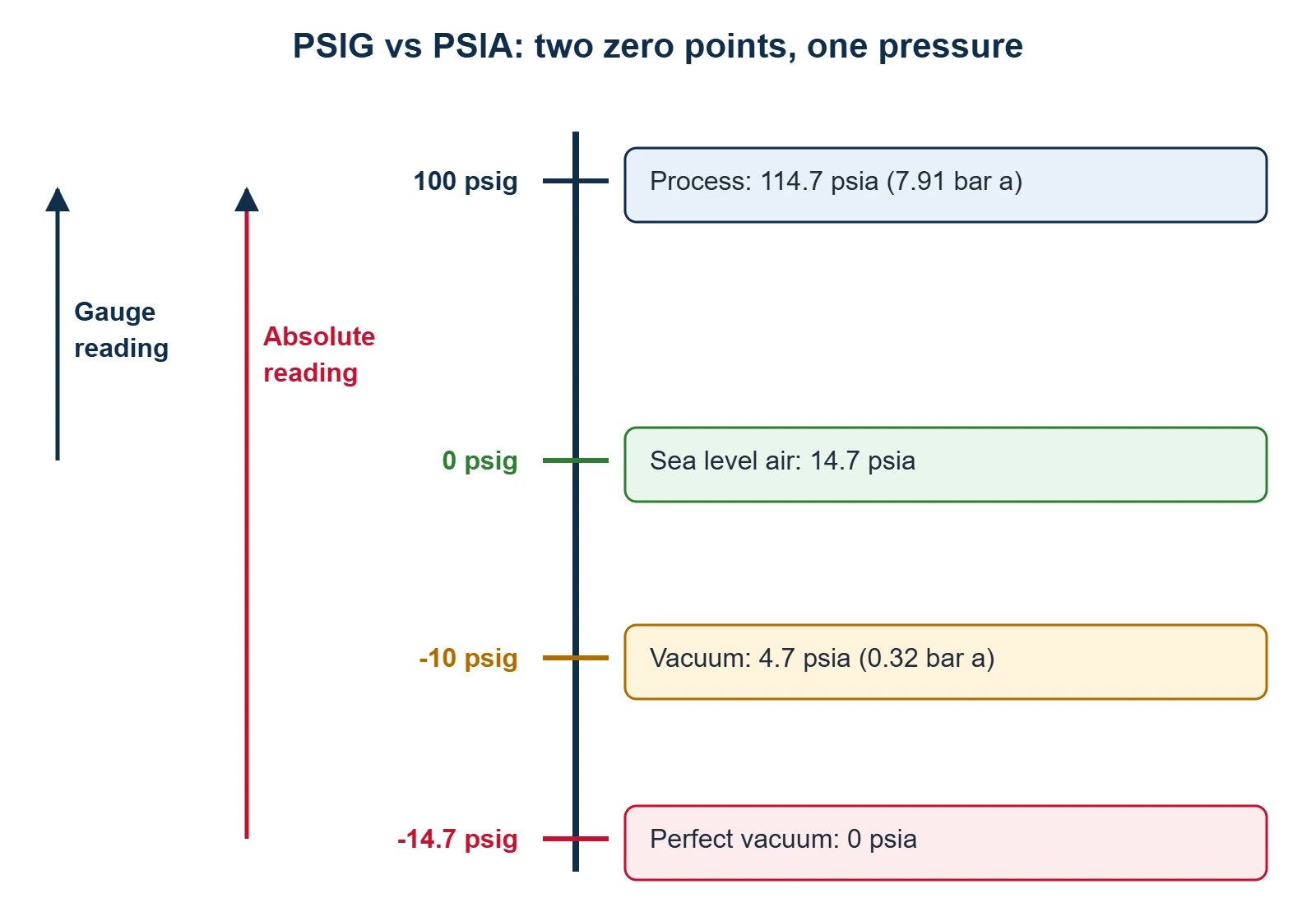
PSIG vs PSIA comes down to the zero point: psig reads pressure above the local atmosphere, and psia reads pressure above a perfect vacuum. At sea level the two differ by about 14.7 psi (1.01 bar), so psia = psig + 14.7, but that gap shrinks at altitude and moves with the weather.
| PSIG vs PSIA point | PSIG (gauge) | PSIA (absolute) |
|---|---|---|
| PSIG vs PSIA zero | Local atmospheric pressure | Perfect vacuum |
| Open to air at sea level | 0 psig | About 14.7 psia |
| Can it go negative? | Yes, down to about -14.7 psig | No, 0 psia is the floor |
| Affected by weather and altitude | Yes, the zero moves | No, the zero is fixed |
| Typical use | Pumps, air headers, hydraulics | Vacuum, gas laws, distillation |
What does psig mean on a pressure gauge?
PSIG means pounds per square inch gauge: the pressure above the air around the instrument. A gauge open to the room reads zero, even though the air is pushing on it with about 14.7 psi (1.01 bar).
Most dial pressure gauges in a plant read psig, because the Bourdon tube has process pressure inside and room air outside. The tube only sees the difference, so a reading of 100 psig means the line is 100 psi above whatever the air is doing that day.
For pump head, air header pressure and hydraulic loads, the psig vs psia question is easy: psig is what you want.
What does psia mean?
PSIA means pounds per square inch absolute: the total pressure measured from a perfect vacuum. A psia instrument open to air at sea level reads about 14.7 psia, not zero.
An absolute sensor seals a vacuum on the reference side of its diaphragm, so the atmosphere outside has no effect on the reading. Engineering ToolBox’s air pressure versus altitude table and every gas law you use need absolute values, which is why psia shows up in compressor, steam and vacuum work.
Besides psig vs psia there is a third reference, sealed gauge. A sealed gauge sensor traps air at a fixed reference, which Wikipedia notes is fixed at 1 bar, so it never shifts with the weather but also never reads exactly zero when vented.
What is the psig vs psia conversion formula?
The psig vs psia formula is psia = psig + Patm, where Patm is the local atmospheric pressure in psia. To go the other way, subtract: psig = psia − Patm.
PSIG vs PSIA: psia = psig + Patm
Reverse: psig = psia − Patm
Patm at sea level = 14.696 psia (1.01325 bar)
Patm at altitude = 14.696 x (1 − 6.8756 x 10^-6 x h)^5.2559, h in ft
Engineering ToolBox gives the same relation as gauge pressure equals system pressure minus atmospheric pressure, and lists 1 atm as 14.696 psi (1.01325 bar). Most people round the psig vs psia offset to 14.7 for quick field work, which is fine when the reading is well above atmosphere.
The altitude line is the standard atmosphere formula from Engineering ToolBox, written in feet. It gives an average value, so for a vacuum or gas psig vs psia conversion, use a real barometer reading instead.
Is 0 psig equal to 14.7 psia?
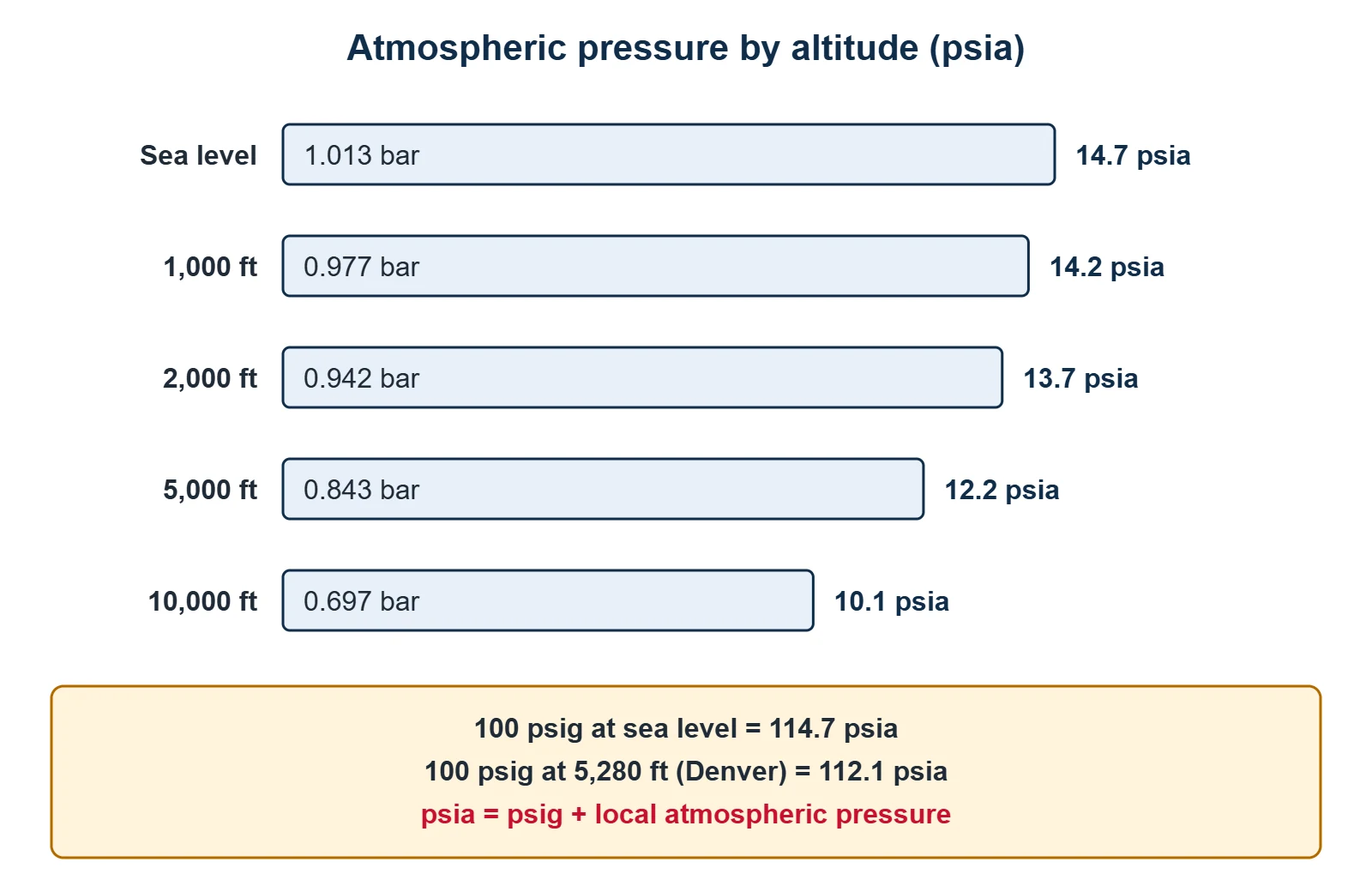
Only at sea level on a standard day. Anywhere else, 0 psig equals the local atmospheric pressure, and at higher sites or on stormy days that can be well below 14.7 psia (1.01 bar).
Engineering ToolBox’s altitude table lists atmospheric pressure at 14.7 psia at sea level, 14.2 psia at 1,000 ft, 13.7 psia at 2,000 ft, 12.2 psia at 5,000 ft and 10.1 psia at 10,000 ft (3,048 m). So the psig vs psia offset at a plant in the Rocky Mountains is about 2.5 psi smaller than on the Gulf Coast.
Weather moves the psig vs psia offset too. Wikipedia’s page on atmospheric pressure lists a record low near 12.6 psi (870 hPa) inside tropical cyclones and highs close to 15.74 psi (1,085 hPa), and it notes pressure drops about 12 hPa for each 100 m near the ground.
Wikipedia’s pressure measurement page gives a simple example: tire gauge pressure rises as a car drives up a mountain, because the air outside drops while the gas inside stays the same. The tire did not change; only the zero of the gauge did, and that is psig vs psia in one picture.
How do you convert psig to psia? A solved example
Find the local atmospheric pressure in psia, then add it to the gauge reading. At a high site, a psig vs psia conversion done with 14.7 gives the wrong answer, as this example shows.
Solved example: psig vs psia for a compressor in Denver
Given: a compressor discharge gauge reads 100 psig (6.89 bar g) at a plant at 5,280 ft (1,609 m). We need psia for a gas density calculation.
- Atmospheric pressure: 14.696 x (1 − 6.8756 x 10^-6 x 5,280)^5.2559 = 12.10 psia (0.834 bar)
- Absolute pressure: 100 + 12.10 = 112.1 psia (7.73 bar a)
- Wrong psig vs psia method, using the sea level value: 100 + 14.7 = 114.7 psia (7.91 bar a)
- Error from using 14.7: 2.6 psi, about 2.3 percent too high
- Compression ratio check: 112.1 / 12.1 = 9.26 in Denver, against 114.7 / 14.7 = 7.80 at sea level
That last line matters when you size or troubleshoot a compressor. The same 100 psig job asks for a higher compression ratio at altitude, because the machine starts from thinner air.
A vacuum psig vs psia conversion works the same way. A gauge showing -10 psig (-0.69 bar g) at sea level means 14.7 − 10 = 4.7 psia (0.32 bar a), and the same gauge reading in Denver would mean only 2.1 psia.
The psig vs psia calculator takes a gauge reading, an altitude or a barometer value, and returns absolute pressure. Enter a negative gauge value for vacuum, and type in a measured barometric pressure when you need better than the standard atmosphere estimate.
Should I use a gauge or absolute pressure transmitter?
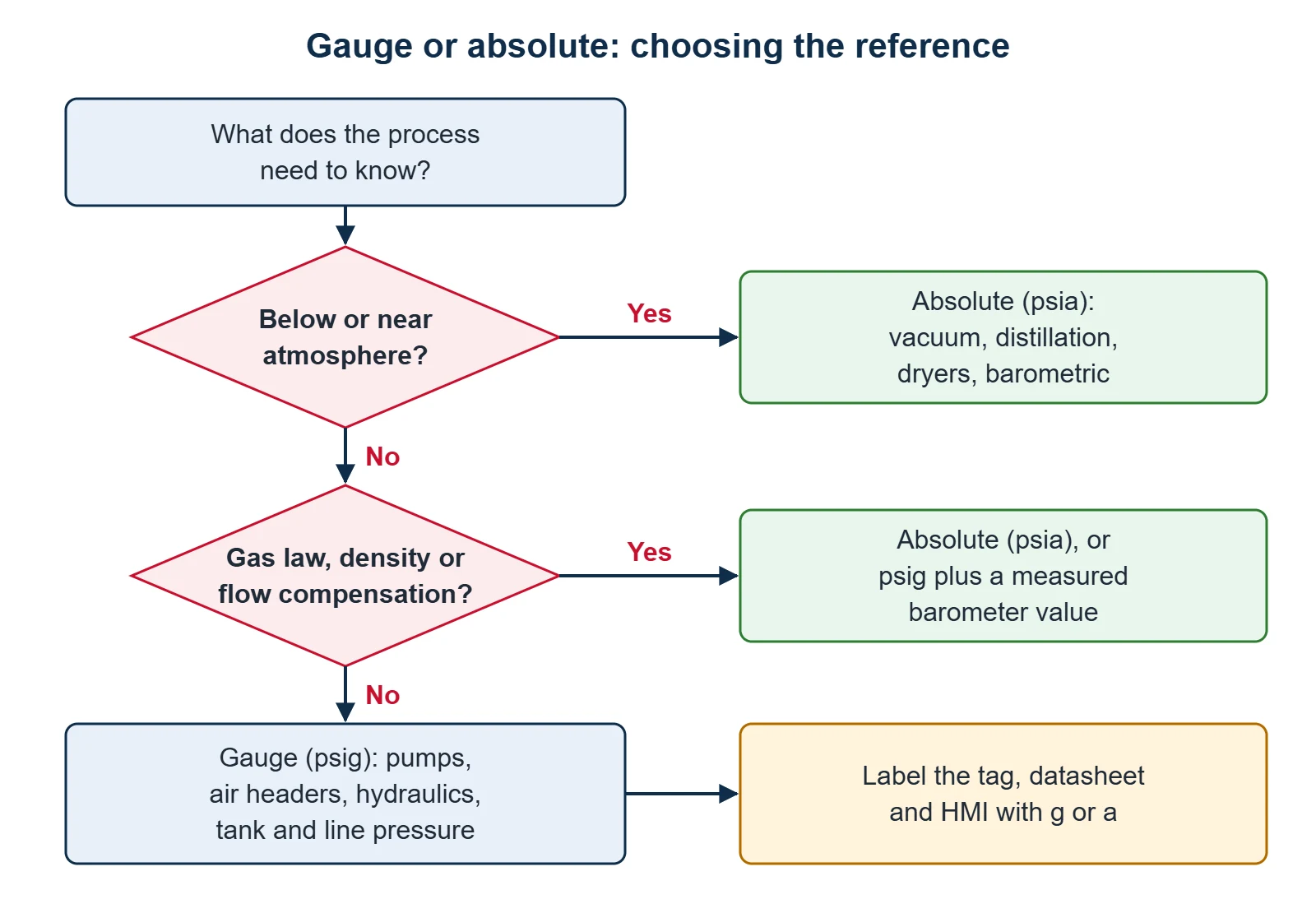
Use a gauge transmitter when the process runs well above atmosphere and you care about pressure relative to the room. Use an absolute transmitter when the process runs near or below atmosphere, or when the value feeds a gas law calculation.
The psig vs psia choice is fixed when you order a pressure transmitter, because the reference is built into the sensor. Inside, a gauge unit vents the back of its diaphragm to air, while an absolute unit seals a vacuum behind it.
| Application | PSIG vs PSIA pick | Why |
|---|---|---|
| Pump discharge, air header, hydraulics | PSIG | Operators think in pressure above the room |
| Vacuum distillation, dryers, evaporators | PSIA | A gauge cannot tell 1 psia from 2 psia on a stormy day |
| Gas flow and density compensation | PSIA | Ideal gas law needs absolute pressure |
| Steam tables and saturation temperature | PSIA, or psig plus local Patm | Steam tables are in absolute units |
| Open tank level by hydrostatic head | PSIG | The tank surface sits at atmosphere too |
| Filter or strainer pressure drop | PSID | Use a differential pressure gauge across both ports |
For a 4 to 20 mA loop, the transmitter output means nothing until the range and reference are on the tag. Our sister blog covers how the 4 to 20 mA current loop carries that signal, and the same scaling logic applies on either side of psig vs psia.
Hot, dirty or corrosive media add one more step. A diaphragm seal works with either reference, and our post on why diaphragm seals are used on transmitters covers the fill fluid and temperature limits.
Can psig be negative?
Yes, and here psig vs psia behave differently: psig goes negative whenever the process is below the local atmosphere. PSIA cannot, because nothing is lower than a perfect vacuum.
The lowest possible gauge reading equals minus the local atmospheric pressure: about -14.7 psig at sea level, and about -12.1 psig in Denver. Many plants read vacuum in inches of mercury instead, but the psig vs psia logic stays the same.
A compound gauge shows both pressure and vacuum on one dial, which suits pump suction lines that swing either side of zero. Our guide to the different types of pressure gauges explains compound, vacuum and absolute dials.
What are common psig vs psia mistakes in the field?
Most psig vs psia mistakes come from a missing letter on a tag, datasheet or HMI. These are the cases we see most often, with the fix for each.
| Symptom | Likely cause | Fix |
|---|---|---|
| New transmitter reads 14.7 high or low | Absolute unit on a gauge loop (a psig vs psia mix-up) | Check the model code; rescale the DCS or swap the unit |
| Gas flow totals off by a few percent | PSIG used in the gas law instead of psia | Add measured Patm, or move to a psia transmitter |
| Vacuum reading drifts with the weather | Gauge sensor on a deep vacuum service | Use an absolute transmitter for vacuum below about 2 psia |
| Plant at altitude reads differently from vendor test | Vendor did the psig vs psia conversion with 14.7 | Redo the math with the site Patm, for example 12.1 psia at 5,280 ft |
| Gauge reads above zero with no pressure | Blocked vent or sealed case on a gauge reference | Clear the vent, check the fill plug and the zero |
Before you replace a sensor for a suspected psig vs psia fault, write down the reference on the nameplate and the unit on the HMI. If one says g and the other says a, you have found the fault.
Snubbers, siphons and valves in the impulse line do not change the psig vs psia reference, but they do affect response and protection. Our gauge accessories page lists these parts.
Pros and cons of psig vs psia
Neither side of psig vs psia is better in general; each answers a different question.
Gauge side of psig vs psia
- PSIG matches what operators expect to see
- Gauge sensors are common and cover most ranges
- Open tank and pump readings make sense directly
- PSIA needs a sealed vacuum reference, so low ranges are harder to build
Absolute side of psig vs psia
- PSIA does not move with altitude or weather
- Gas laws, steam tables and vacuum work need it
- PSIG needs a vent that can clog or let in moisture
- PSIG readings from two sites cannot be compared without Patm
Myth vs fact about psig vs psia
A few beliefs about psig vs psia cause real errors on data sheets. These are the ones we hear most on site.
Every psig vs psia conversion adds 14.7.
A correct psig vs psia conversion adds local atmospheric pressure, about 12.2 psia at 5,000 ft (1,524 m).
Plain psi always means gauge.
Plain psi is ambiguous, so state the reference on every tag and datasheet.
An absolute transmitter is just a more accurate gauge transmitter.
Gauge and absolute sensors measure from different zeros, so swapping one for the other shifts the reading by Patm.
The suffix after psi is the official SI way to show the reference.
NIST says not to attach extra letters to a unit and to put them on the quantity instead.
NIST’s guide to SI style, Chapter 7 of Special Publication 811, states in section 7.4 that it is incorrect to attach letters to a unit to give extra information. US plants still write psig and psia, so always write the letter and never leave a bare psi.
Industrial applications of psig vs psia
Every plant uses both sides of psig vs psia, often on the same unit. These are typical psig vs psia cases by industry.
Refinery
Vacuum distillation columns run below atmosphere, so their overhead pressure is measured in psia. Pump discharge and fuel gas headers on the same unit stay in psig.
Water and wastewater plant
Pump discharge, filter and distribution pressures are read in psig. Submersible level sensors in wells and wet wells use a vented gauge reference so the weather does not show up as level change.
HVAC
Refrigeration manifold gauges read psig, while many saturation tables list psia. Technicians in high altitude cities must use the local Patm as the psig vs psia offset before reading saturation temperature.
Chemical plant
Vacuum dryers, reactors and solvent recovery run on absolute transmitters for stable control. Nitrogen blanketing and utility headers stay on psig gauges.
Frequently asked questions
What is the main psig vs psia difference for beginners?
The only psig vs psia difference is the zero point. PSIG starts at the local air pressure, so an open gauge reads 0, while psia starts at a perfect vacuum, so the same open sensor reads about 14.7 at sea level. Add atmospheric pressure to psig to get psia.
Is the pressure on a tire gauge psig or psia?
A tire gauge reads gauge pressure, so 32 psi on the dial means 32 psig (2.21 bar g). The absolute pressure inside the tire is about 46.7 psia at sea level. Because the reference is the outside air, the same tire shows a higher gauge reading on a mountain road.
How do I do a psig vs psia conversion at high altitude?
At altitude the psig vs psia offset is the local atmospheric pressure, not 14.7, so subtract that. At 5,000 ft (1,524 m) Engineering ToolBox lists about 12.2 psia, so 50 psia equals about 37.8 psig there. For vacuum or gas work, read a calibrated barometer at the site and use that value instead of the table.
Why does the psig vs psia choice matter for gas laws?
The ideal gas law relates pressure to the number of molecules, so it needs pressure measured from true zero. Using psig makes a 0 psig gas look like it has no pressure at all, which is wrong. Engineering ToolBox notes that both pressure and temperature must be absolute in gas calculations.
Do I need an absolute transmitter for every vacuum application?
Not always: the psig vs psia pick depends on vacuum depth. A gauge or compound transmitter works for rough vacuum where you only care about the drop below the room. For deep vacuum, such as distillation or drying under a few psia, choose an absolute transmitter, because weather swings of a few tenths of a psi would swamp the reading.
Where does psid fit in the psig vs psia picture?
PSID means pounds per square inch differential, the difference between two process points. It ignores atmosphere entirely, like a filter drop of 5 psid (0.34 bar). Wikipedia lists psia, psig and psid as the three common suffixes, and a differential gauge or transmitter reads it directly.