

Magnetic Level Gauge: How It Works, Float Sizing and Troubleshooting
Table of Contents
- How does a magnetic level gauge work?
- What are the main parts of a magnetic level gauge?
- What is the difference between flags and a bargraph indicator?
- How do you size a magnetic level gauge float for specific gravity?
- Magnetic level gauge float calculation: a solved example
- Solved example
- Magnetic level gauge float buoyancy calculator
- Can a magnetic level gauge measure interface level?
- How do you install a magnetic level gauge correctly?
- Why is my magnetic level gauge reading wrong?
- Is a magnetic level gauge better than a sight glass?
- Pros and cons of a magnetic level gauge
- Pros
- Cons
- Myth vs fact: magnetic level gauge
- Industrial applications of the magnetic level gauge
- Refinery
- Water and wastewater plant
- HVAC
- Chemical plant
- Frequently asked questions
- What is the working principle of a magnetic level gauge?
- How do you reset flags that are out of step on the indicator?
- What is the lowest specific gravity a float can handle?
- Why does the magnetic level gauge read low when the liquid gets hotter?
- How often should the chamber and float be cleaned?
- Which valve should you open first when commissioning the magnetic level gauge?
A magnetic level gauge shows tank level with a magnetized float inside a side chamber and a column of flags outside it, so you can read level without glass or power. It’s written for technicians and engineers who need to size the float, install the magnetic level gauge correctly and fix the usual faults, such as a stuck float or flags that no longer agree with the tank.
Every limit quoted here comes from a named manufacturer manual or data sheet. If you are new to the wider family of level devices, the overview on the basics of level measurement is a good starting point.
How does a magnetic level gauge work?
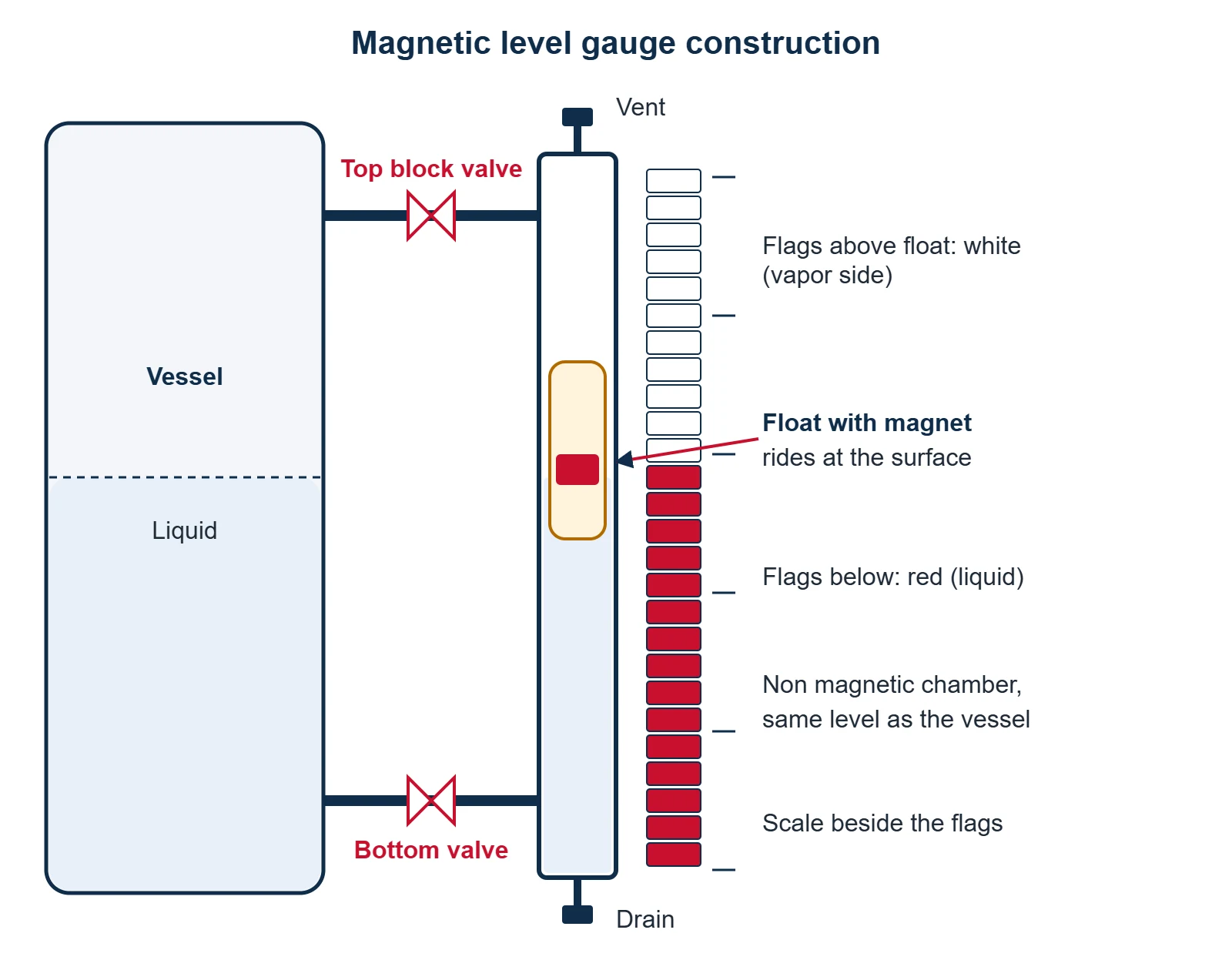
A magnetic level gauge works on the communicating vessel principle: the liquid in a non magnetic chamber bolted to the tank stands at the same height as the liquid in the tank. A float carrying a permanent magnet rides on that surface, and its field turns two colored flags or drags a shuttle outside the chamber, so the colored column shows level with no power supply.
What are the main parts of a magnetic level gauge?
A magnetic level gauge has five main parts: the chamber, the float with its magnet, the indicator (flags or a shuttle), the scale and the process connections with block valves. Vent and drain plugs at the ends let you empty and clean the chamber.
The magnetic level gauge chamber is a non magnetic pipe, so the magnet field passes through the wall. WIKA lists stainless steels, Hastelloy and Inconel for metal chambers, plus PTFE and PVC for corrosive service.
The magnetic level gauge float is a sealed shell with a magnet near the liquid line. Emerson’s Rosemount 9930 manual says a float should normally ride about 70 percent submerged, and ABB’s KM26 manual gives 70 to 80 percent.
The indicator rail clamps to the outside of the chamber. Emerson’s manual says each magnetic level gauge flag rotates 180 degrees, red for liquid and silver for vapor, and one flag assembly can run up to 20 ft (6.1 m).
What is the difference between flags and a bargraph indicator?
Flags are small magnetic wafers that flip one by one as the float passes, while a bargraph style indicator uses a single magnetic shuttle that slides up and down beside the scale. Both read the same magnetic level gauge float.
A flag rail must be reset after maintenance. Emerson notes that if you clamp the indicator on while liquid is already present, only the flag next to the float turns red, and the cure is to drain and refill the chamber.
ABB’s manual notes that a bargraph magnetic level gauge does not need the flag recoupling step. For resolution, the Rosemount 9930 data sheet gives about 1/4 inch (6.4 mm).
How do you size a magnetic level gauge float for specific gravity?
You size a magnetic level gauge float so that its weight is a fixed share of the buoyancy it would get when fully submerged in the lightest liquid you expect. Archimedes’ principle gives that buoyancy from float volume and specific gravity (SG).
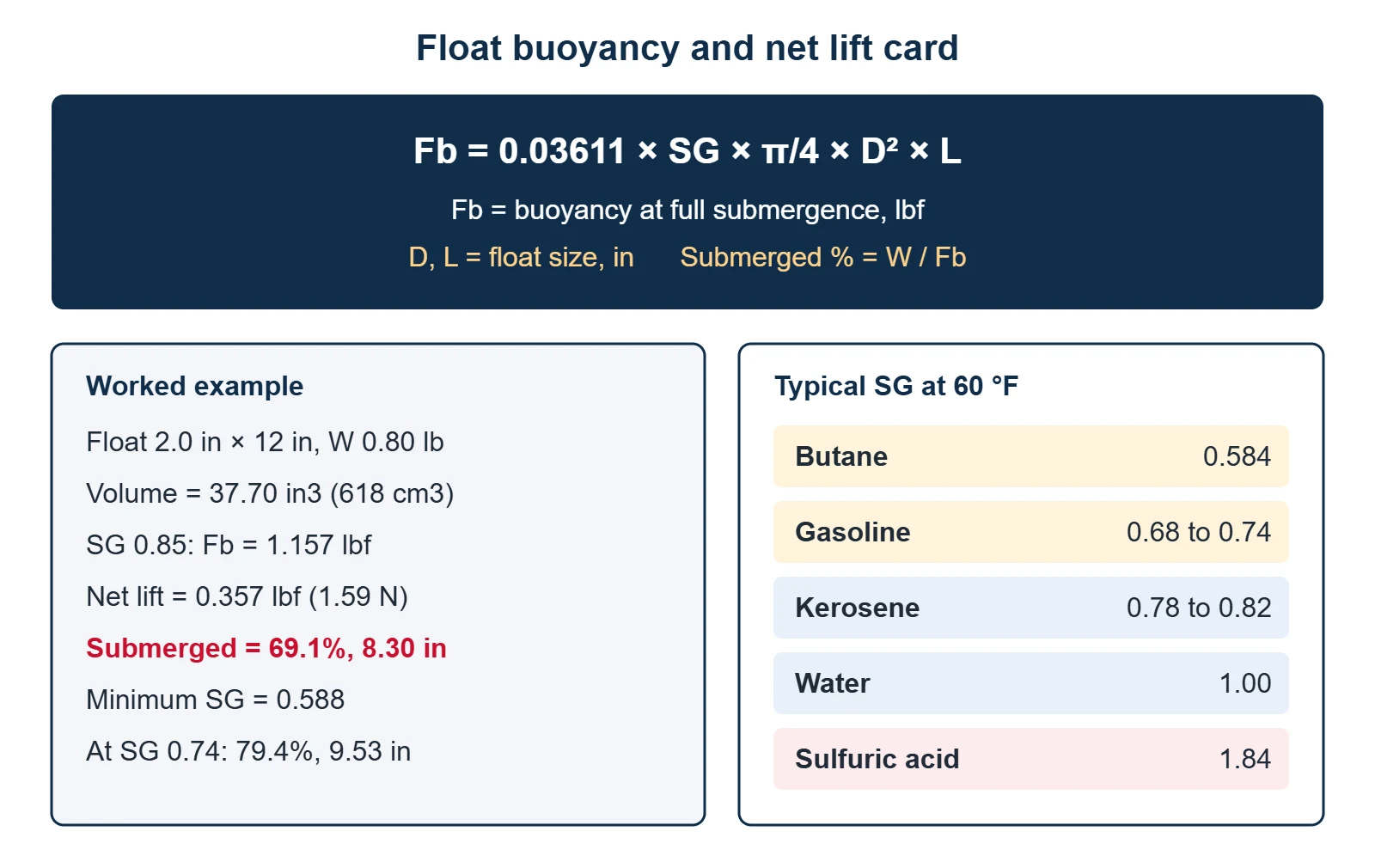
Fb = 0.03611 × SG × (π/4) × D² × L
Net lift = Fb − W; Submerged % = 100 × W / Fb; Minimum SG = W / (0.03611 × (π/4) × D² × L)
Where: Fb = buoyancy at full submergence, lbf; D = float diameter, in; L = float length, in; W = float weight, lb; 0.03611 = water weight, lb/in3 (62.4 lb/ft3 ÷ 1,728)
The minimum SG is where the float would sink completely, so a magnetic level gauge must run well above it. Penberthy’s data sheet shows how material sets this limit: a standard 316 stainless float works down to an SG of 0.49, titanium to 0.37 and CPVC only to 0.86.
Density also changes with temperature, and that affects every magnetic level gauge. The Engineering ToolBox specific gravity table lists butane at 0.584, gasoline at 0.68 to 0.74 and kerosene at 0.78 to 0.82, all at 60 °F (15.6 °C), so always size for the hottest, lightest case.
Magnetic level gauge float calculation: a solved example
For a 2.0 inch by 12 inch float weighing 0.80 lb in a fuel oil of SG 0.85, the float rides 69.1 percent submerged with a net lift of 0.357 lbf.
Solved example
Given: float diameter 2.0 inches (50.8 mm), length 12 inches (304.8 mm), weight 0.80 lb (0.363 kg), process SG 0.85. Engineering ToolBox lists fuel oils at 0.82 to 0.95.
- Volume = (π/4) × 2.0² × 12 = 37.70 in3 (618 cm3).
- Buoyancy in water = 37.70 × 0.03611 = 1.361 lbf; in the oil, Fb = 1.361 × 0.85 = 1.157 lbf (5.15 N).
- Net lift = 1.157 − 0.80 = 0.357 lbf (1.59 N), so the float floats.
- Submerged share = 0.80 / 1.157 = 69.1 percent, or 8.30 inches (210.8 mm) of the 12 inch body.
- Minimum SG = 0.80 / 1.361 = 0.588. If the liquid drops to SG 0.74, the float sinks to 79.4 percent (9.53 inches), so the reading falls about 1.23 inches (31.2 mm).
That last step is why a magnetic level gauge reads low when the liquid gets lighter. ABB’s KM26 manual adds that a large SG change can mean a new float.
Magnetic level gauge float buoyancy calculator
Can a magnetic level gauge measure interface level?
Yes, a magnetic level gauge can track the interface between two liquids if the float is weighted to sink through the light liquid and float on the heavy one. The two liquids must differ enough in density for the float to tell them apart.
Manufacturers set that gap differently. The Rosemount 9930 data sheet asks for a minimum SG difference of 0.11, while Penberthy's sheet asks for at least 0.2, so check the rule for the exact float you buy.
The magnetic level gauge chamber has to see both layers. Keep the top nozzle in the light liquid and the bottom nozzle in the heavy one.
For an oil over water separator, a magnetic level gauge with an interface float is often paired with a level transmitter for the control loop. The magnetic level gauge flags then act as the local check.
How do you install a magnetic level gauge correctly?
Mount the chamber plumb, fit block valves on both nozzles, put the float in with the TOP mark up and bring the magnetic level gauge into service by opening the top valve first, slowly. Emerson's manual is clear that the chamber must be vertical or the float can uncouple from the indicator.
Block valves let you drain and clean the magnetic level gauge later. Our instrument valves and manifolds range covers the small bore isolation valves this hookup needs.
Shipping gaskets are only for transport, so fit a gasket rated for your process before startup.
On startup, close all vents and drains, then open the top valve slowly so pressure equalizes through the vapor space. Open the bottom valve only after the chamber reaches process pressure, because Emerson warns that a bottom first start can slam the float into the top and damage it.
On shutdown, close the bottom valve first, then the top. Never use the vent or drain as a pressure relief.
A taller magnetic level gauge needs support along the rail. Emerson recommends stainless tie wires on units over 5 ft (1.5 m), and float stops installed between the nozzles on side mount designs.
Why is my magnetic level gauge reading wrong?
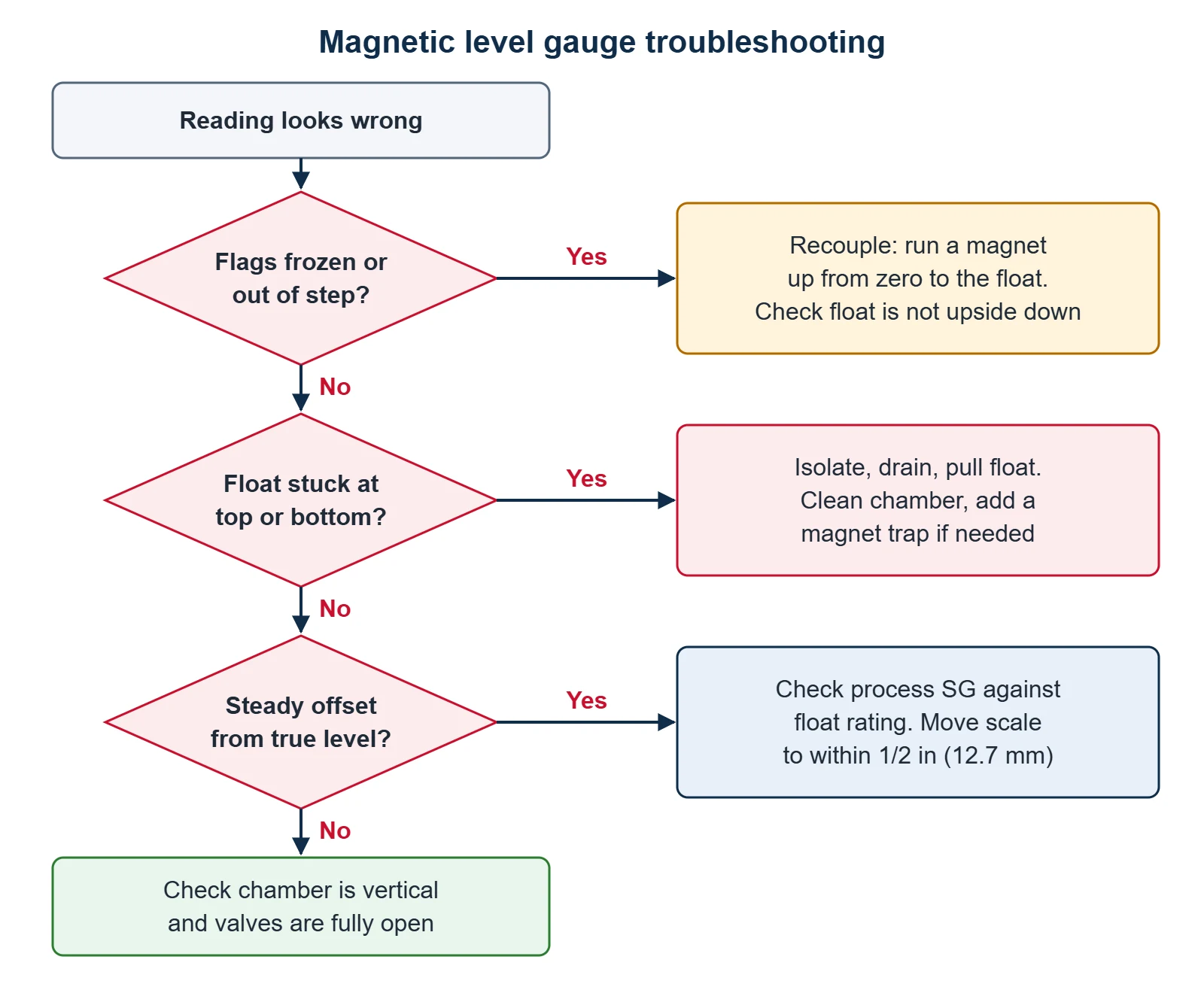
Most magnetic level gauge faults come from three causes: the indicator has lost coupling with the float, the float is stuck, or the liquid density differs from the float rating. The magnetic level gauge fault table below follows that order.
| Symptom | Likely cause | Fix |
|---|---|---|
| Flags out of step, a red block above white ones | Indicator decoupled, often from surge or rapid filling | Run a hand magnet up from zero to the float, then throttle the process valves |
| Magnetic level gauge stuck at full scale after startup | Bottom valve opened first under pressure | Shut in, drain, inspect the float for damage, restart top valve first |
| Float stuck mid chamber | Magnetic particles, scale or solids on the float | Drain, clean the float and chamber; ABB suggests magnet traps in the lines |
| Steady low reading | Process SG below the float rating | Check real SG; order a float for the minimum SG |
| Weak or no coupling | Float upside down (half strength per Emerson) or demagnetized | Reinstall TOP up; replace a float exposed above 1,100 °F (593 °C) |
| Small fixed offset | Scale moved on its clamps | Loosen clamps and set the scale within 1/2 inch (12.7 mm) of true level |
| Solids in the magnetic level gauge chamber | Fluid freezes or sets up when cool | Heat trace the chamber or use a PTFE coated float |
Recoupling is a one minute job: hold a permanent magnet at zero, slide it up the rail until it meets the float's field, then pull it away quickly. If flags drift again, partly close the process valves to calm surging, as Emerson advises.
Emerson's manual recommends cleaning and inspecting at least once a year, and more often in dirty service. Pull the float, check it for wear and scrub the chamber wall.
Is a magnetic level gauge better than a sight glass?
For hot, high pressure, toxic or flammable service, a magnetic level gauge is usually the better choice because the process stays inside a sealed metal chamber. A sight glass is cheaper and shows the liquid itself.
The control.com textbook notes that sightglass glass can crack from thermal or mechanical shock. A magnetic level gauge removes the glass from the pressure boundary, and you can add level switches or a transmitter on the same chamber.
WIKA rates its WMI series from −320 to 1,000 °F (−195 to 537 °C) and from full vacuum to 5,000 psi (344.7 bar). Emerson's Rosemount 9930 covers −260 to 850 °F (−162 to 454 °C) with floats up to 4,000 psig (275.8 bar) at 100 °F (38 °C).
Pros and cons of a magnetic level gauge
A magnetic level gauge gives a large, readable column with no power and no glass in the pressure boundary, but it depends on a float sized for one density range.
Pros
- No power needed; the magnet does the work
- Scales read in feet, inches or percent
- Sealed metal chamber for high pressure and temperature
- Switches and transmitters clamp to the same chamber
- Works for interface service with the right float
Cons
- Reading shifts if SG drifts from the float rating
- Float can stick in dirty, waxy or magnetic service
- Flags can decouple under surge or fast filling
- Single units top out near 20 ft (6.1 m)
- A magnetic level gauge needs vertical mounting
If the float sticks often, a non contact option may suit you better; our guide to how a radar level transmitter works covers that route. Guided wave radar is another option, and this guided wave radar overview shows how a probe can sit inside the same style of chamber.
Myth vs fact: magnetic level gauge
Most magnetic level gauge complaints trace back to beliefs that do not match the manuals.
Any magnetic level gauge float fits any liquid.
Each float is built for a design SG; ABB notes the magnetic level gauge reads low when SG drops below it.
Magnetic level gauge flags that disagree with the tank mean a broken float.
Usually the indicator has decoupled, and a hand magnet recouples it in a minute.
The order you open the valves does not matter.
Open the top valve first, slowly; a bottom first start can lodge and damage the float.
A magnetic level gauge needs a power supply to drive the flags.
WIKA says the indicator runs on magnetic coupling alone, with no power.
Industrial applications of the magnetic level gauge
The magnetic level gauge fits wherever a sight glass would be a safety or leak risk.
Refinery
Butane and LPG drums use a titanium float magnetic level gauge because the liquid SG sits near 0.58. Penberthy rates titanium floats down to 0.37.
Water and wastewater plant
Chemical day tanks for sodium hypochlorite often use a PVC or CPVC magnetic level gauge. The plastic resists corrosion, but CPVC floats need SG 0.86 or more.
HVAC
Boiler feed and condensate receivers use a magnetic level gauge with clamp on switches for pump control. Size the float for hot water.
Chemical plant
Sulfuric acid storage at SG 1.84 uses an alloy magnetic level gauge. Interface units on decanters track an organic layer over water.
On the product side, our level gauges page lists local indicators, and level switches can be clamped beside the flag rail for alarms. For a pressure based cross check, read our note on hydrostatic level measurement with DP transmitters.
The general principle and its history are summed up on the Wikipedia magnetic float gauge page. For the installation and recoupling steps, the Rosemount 9930 reference manual is the most detailed public source we found.
Frequently asked questions
What is the working principle of a magnetic level gauge?
A magnetic level gauge uses communicating vessels: liquid in the side chamber matches the tank level. A float with a permanent magnet rides on that surface, and its field flips colored flags or moves a shuttle on the outside rail. No power is needed, and the colored column height equals the liquid height in the chamber.
How do you reset flags that are out of step on the indicator?
Hold a permanent magnet at the zero mark and slide it up the rail until it meets the float's field, then pull it away quickly. This recouples the flags. If they drift again soon, check for surging, a float installed upside down, or a chamber that is not mounted plumb.
What is the lowest specific gravity a float can handle?
It depends on float material and size; the Rosemount 9930 data sheet lists a minimum of 0.40, Penberthy rates titanium floats to 0.37, and WIKA quotes 0.35 for its design. Penberthy's CPVC float needs at least 0.86. Always size for the lightest expected liquid.
Why does the magnetic level gauge read low when the liquid gets hotter?
Hot liquid is less dense, so the float sinks deeper to displace its own weight. In our worked example, dropping SG from 0.85 to 0.74 pushes submergence from 69.1 to 79.4 percent, lowering the reading about 1.23 inches. Size the float for the hottest, lightest operating case.
How often should the chamber and float be cleaned?
Emerson's Rosemount 9930 manual recommends cleaning and inspecting at least once a year, and more often in severe or dirty service. Isolate the magnetic level gauge, drain it, pull the float to check for wear, scrub the chamber wall, and refit the drain flange with a gasket suited to the process fluid.
Which valve should you open first when commissioning the magnetic level gauge?
Open the top process valve first and slowly, so pressure equalizes through the vapor space. Open the bottom valve only after the chamber reaches process pressure. Opening the bottom valve first can drive the float into the top of the chamber and damage both the float and the chamber.