
How a Radar Level Transmitter Works: Range, Setup & Calculator
Table of Contents
- How does a radar level transmitter work?
- What is a radar level transmitter?
- How does time of flight radar measure level?
- What is FMCW radar and why do most new units use it?
- Which frequency is better for a radar level transmitter, 26 GHz or 80 GHz?
- What is the formula for level from measured distance?
- How do you set the range on a radar level transmitter?
- How do you calculate level and mA output? A solved example
- Solved example
- Radar level transmitter calculator
- How do you install a radar level transmitter on a nozzle?
- Why does a radar level transmitter read wrong?
- How does dielectric constant affect a radar level transmitter?
- How do you calibrate a radar level transmitter?
- What is the difference between radar and ultrasonic level transmitter?
- Pros and cons of a radar level transmitter
- Pros
- Cons
- Myth vs fact: radar level transmitter
- Industrial applications of the radar level transmitter
- Refinery
- Water and wastewater plant
- HVAC
- Chemical plant
- Frequently asked questions
- How does a radar level transmitter work in a closed tank?
- What is the empty distance setting on a radar level transmitter?
- Can a radar level transmitter measure through foam on the surface?
- What is the minimum dielectric constant for a radar level transmitter?
- Why does my radar level transmitter show full when the tank is half empty?
- What mA does a radar level transmitter send when it loses the echo?
A radar level transmitter measures liquid level by timing a microwave echo off the product surface. This page covers how it works, how to set its range and how to fix bad readings, for technicians, plant engineers and students who must make the 4 to 20 mA signal match the tank.
Microwaves travel at the speed of light, about 983,571,056 ft/s (299,792,458 m/s), and barely care about vapor, temperature or pressure. Most field problems come from setup and mounting, not from the electronics.
How does a radar level transmitter work?
A radar level transmitter sends microwaves from an antenna on the tank roof, measures how long the echo takes to return from the liquid surface and turns that time into distance. It subtracts the distance from the empty distance you entered to get level, then scales that level to a 4 to 20 mA output between the 0% and 100% points you configured.
What is a radar level transmitter?
A radar level transmitter is a non-contact instrument that measures distance to a surface with microwaves and sends level as a 4 to 20 mA or digital signal. A level switch only says high or low, while the radar level transmitter gives a continuous value.
To see where radar sits among other technologies, read this overview of level transmitter types and this side by side of guided wave and non-contact radar.
In the field you handle three parts: the antenna (cone, horn, lens or dish), the flange or thread on a nozzle, and the electronics head. You will find it beside other continuous devices in our level transmitter range, often paired with an independent high level switch.
How does time of flight radar measure level?
A pulse radar level transmitter sends short microwave bursts, times the round trip and uses D = c × t / 2 to get distance. The Endress+Hauser learning center on radar measurement gives the same pair of equations, distance from time and then level L = E minus D.
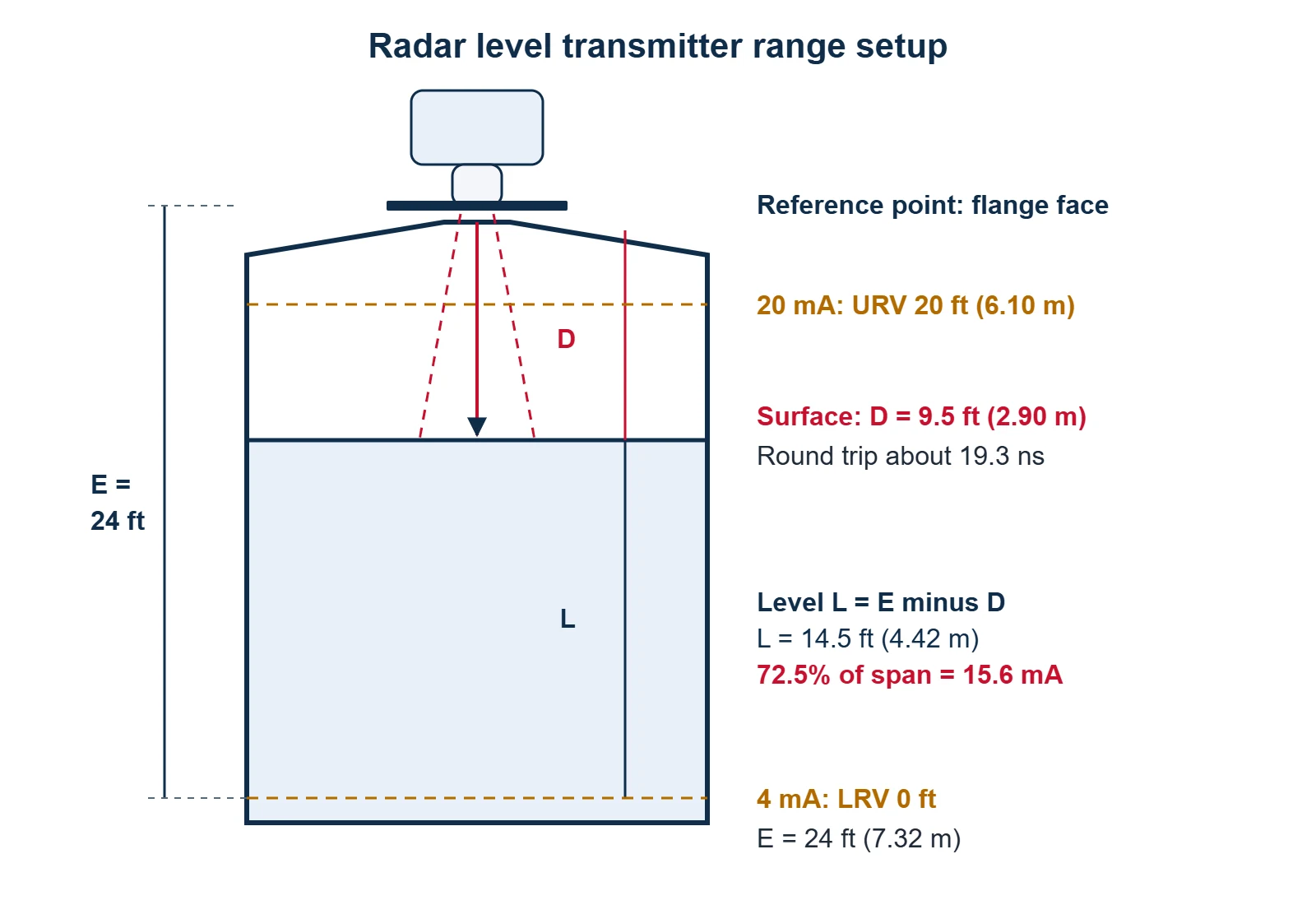
The times are tiny. For a surface 9.5 ft (2.90 m) below the antenna, the round trip takes about 19.3 nanoseconds.
What is FMCW radar and why do most new units use it?
An FMCW radar level transmitter sends a continuous signal whose frequency sweeps upward, and the difference between sent and received frequency is proportional to distance. A Fourier transform turns that difference into an echo curve, so the radar level transmitter can pick the true surface from other reflections.
KROHNE states that its 80 GHz units sweep 78 to 82 GHz, a 4 GHz bandwidth, against 2 GHz for a 24 to 26 GHz radar, and that the wider sweep separates targets only 4 inches (10 cm) apart. Better resolution helps when the surface sits near a weld seam or the tank bottom.
Which frequency is better for a radar level transmitter, 26 GHz or 80 GHz?
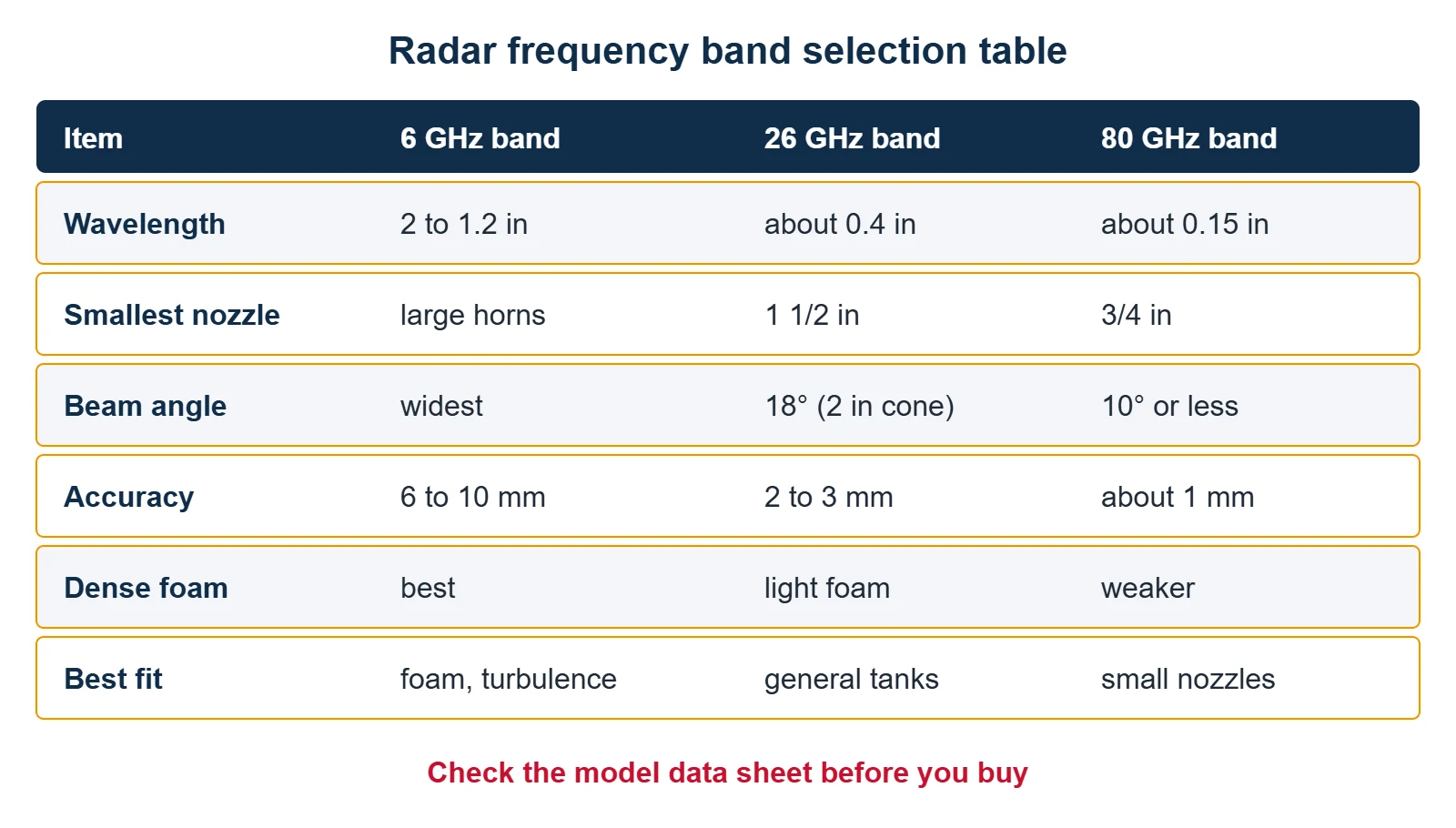
An 80 GHz radar level transmitter gives a narrower beam and fits smaller nozzles, while 26 GHz and lower bands cope better with heavy foam and turbulence.
Emerson’s white paper on frequency lists the mid band, 24 to 29 GHz, at a wavelength of about 0.4 inches (10 mm) and the high band, 75 to 85 GHz, at 0.15 inches (4 mm). It says the high band supports nozzles from 3/4 inch, the mid band needs 1 1/2 inches or more, and dense foam is best handled by 6 or 10 GHz.
Emerson’s Rosemount 5408 manual, a 26 GHz unit, lists an 18 degree beam for a 2 inch cone. The 1408H reference manual for an 80 GHz radar level transmitter gives 10 degrees and a beam 5.7 ft (1.7 m) wide at 32.8 ft (10 m).
What is the formula for level from measured distance?
Level equals empty distance minus measured distance, and the output is 4 mA plus 16 mA times the fraction of span. Every radar level transmitter does this math inside, so you only enter the reference points.
D = c × t / 2
L = E − D
% = (L − LRV) / (URV − LRV) × 100
I = 4 + 16 × % / 100 mA
Where: t = round trip time, E = empty distance, D = measured distance, LRV and URV = level at 4 and 20 mA.
The reference point is usually the flange face or thread. Emerson calls E the Reference Height, the distance from that point to Zero Level.
How do you set the range on a radar level transmitter?
Enter the empty distance to the 0% level, set the 4 mA and 20 mA level points, and keep 20 mA below the blind zone at the top. That plus the alarm current is the whole range setup on a radar level transmitter.
- Empty distance (E): measure from the flange face to the 0% point, using the tank drawing rather than a tape through a manway.
- 4 mA point (LRV): usually 0 ft, or the top of a sump you do not care about.
- 20 mA point (URV): the 5408 manual says it should sit below the reduced accuracy zone and the Upper Null Zone, where no measurement is made.
- Alarm current: Rosemount standard alarms are 3.75 mA or less and 21.75 mA or more, and NAMUR NE43 low alarm is 3.6 mA or less.
If the signal passes a barrier or signal isolator, check that it passes currents outside 4 to 20 mA. If it doesn’t, the alarm gets clipped and nobody sees the fault.
How do you calculate level and mA output? A solved example
Subtract the measured distance from the empty distance, divide by the span and scale to 4 to 20 mA. This radar level transmitter example uses an 80 GHz unit on a water tank.
Solved example
Empty distance E = 24 ft (7.32 m), LRV = 0 ft, URV = 20 ft (6.10 m), beam angle 10 degrees, and the radar level transmitter reads D = 9.5 ft (2.90 m).
- Level: L = 24 minus 9.5 = 14.5 ft (4.42 m).
- Percent of span: 14.5 / 20 × 100 = 72.5%.
- Output: I = 4 + 16 × 0.725 = 15.6 mA.
- Round trip time: t = 2 × 9.5 / 983,571,056 = 19.3 ns.
- Beam width at the surface: 2 × 9.5 × tan(5°) = 1.66 ft (0.51 m).
Radar level transmitter calculator
How do you install a radar level transmitter on a nozzle?
Mount it away from the wall and inlet, keep the nozzle short and smooth, and let the antenna clear the nozzle where the manual asks. Most bad readings on a new radar level transmitter trace back to the nozzle.
- Wall distance: the 5408 and 1408H manuals give a minimum of 8 inches (200 mm), with half the tank radius recommended for liquids.
- Cone antenna: the 5408 manual wants the cone at least 0.4 inches (10 mm) below the nozzle.
- 80 GHz lens: the 1408H manual allows a 2 inch (50 mm) nozzle up to 7.9 inches (200 mm) tall, with a smooth inside.
Keep fill streams, agitator blades and ladders out of the beam, since every steel edge is a target. Our post on ultrasonic level sensor installation mistakes covers several habits that hurt radar too.
Why does a radar level transmitter read wrong?
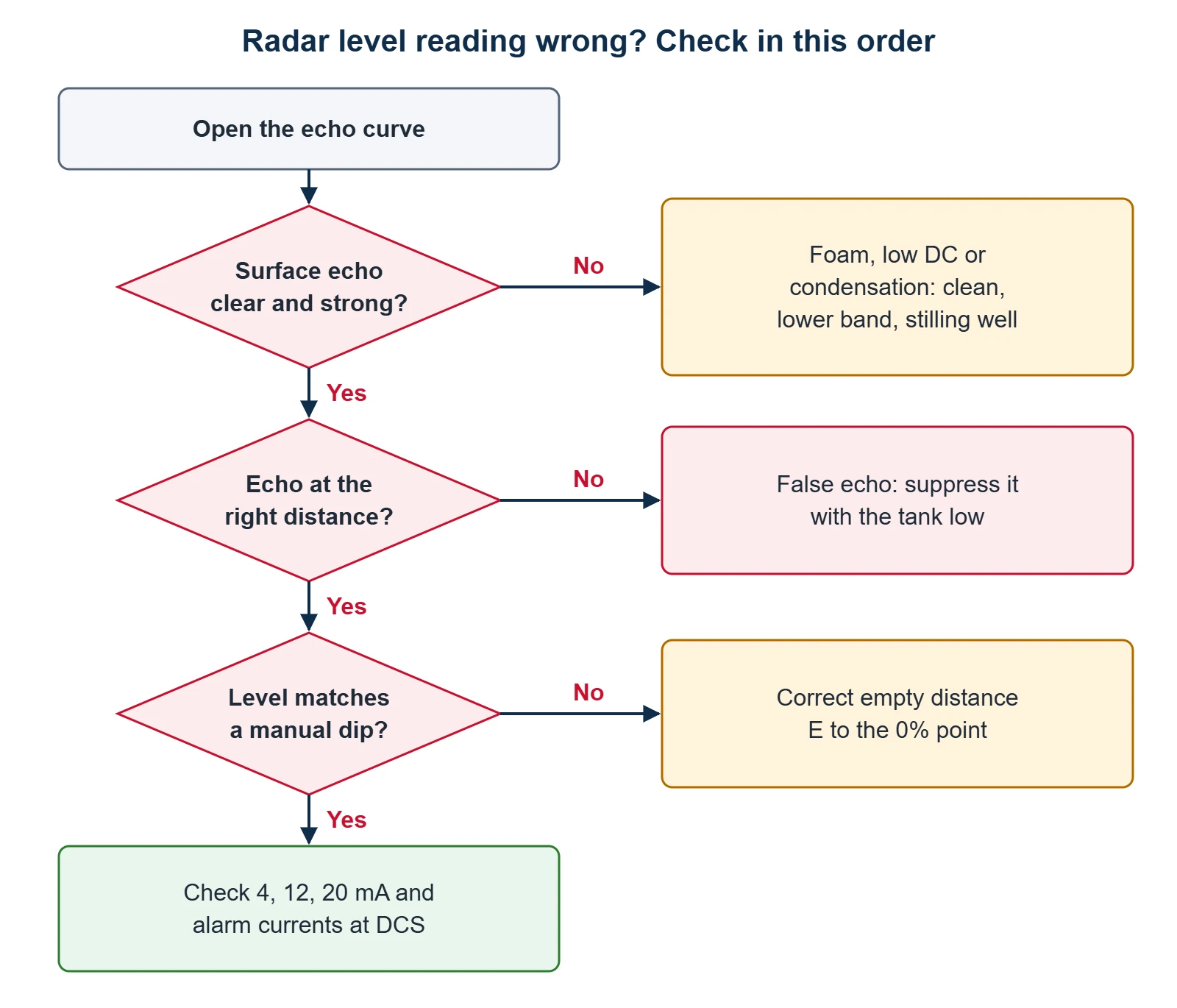
Most wrong readings come from false echoes, weak echoes from foam or low dielectric liquids, or a wrong empty distance. Read the echo curve of the radar level transmitter first.
| Symptom | Likely cause | Fix |
|---|---|---|
| Radar level transmitter stuck at one level | False echo from a ladder or nozzle edge | Run false echo suppression with the tank low |
| Same offset at every level | Empty distance taken to the wrong point | Correct E against a manual dip |
| Signal lost with foam | Foam scatters the microwave energy | Lower band, stilling well or foam control |
| Weak echo on oil or solvent | Low dielectric constant | Check minimum DC, stilling well or guided wave radar |
| Radar level transmitter reads full | Condensation on the antenna or level in the null zone | Clean or purge, keep URV below the null zone |
| DCS shows 0 ft during a fault | Alarm current clipped or read as empty | Pass 3.6 to 22.5 mA and map alarms as faults |
Emerson’s white paper notes that a turbulent surface can cut the returned signal by as much as 90 percent. Raise damping on the radar level transmitter in small steps so you do not hide a real fast fill.
How does dielectric constant affect a radar level transmitter?
The higher the dielectric constant, the stronger the echo, so water is easy and light hydrocarbons are hard. A radar level transmitter needs enough reflected energy to separate the surface from noise.
The relative permittivity table at Engineering ToolBox lists water at about 80, methanol at 33.6 and benzene at 2.3. The 1408H manual gives a minimum dielectric constant of 2, and range grows from 33 ft (10 m) to 49 ft (15 m) above a value of 10.
How do you calibrate a radar level transmitter?
Verify a radar level transmitter against a known level and correct the empty distance if needed, then check the 4 to 20 mA loop at the DCS.
- Confirm E, LRV, URV, damping and alarm settings against the tank datasheet.
- Compare the head reading with a manual dip or a level gauge on the same tank.
- If the offset is constant, adjust E; if it grows with level, look for a false echo.
- Drive 4, 12 and 20 mA with a loop calibrator or simulation mode and confirm 0%, 50% and 100% at the DCS.
The 4 to 20 mA scaling calculator converts any loop current to level. HART lets you read distance and echo strength remotely, as our HART vs Fieldbus comparison explains.
What is the difference between radar and ultrasonic level transmitter?
Radar uses microwaves and ignores vapor and temperature, while ultrasonic uses sound, which changes speed with gas temperature. A radar level transmitter is the usual pick for closed process tanks, ultrasonic for open sumps.
Hydrostatic DP transmitters measure level from bottom pressure and depend on density, which a radar level transmitter does not. Our guide to hydrostatic level measurement covers that method.
Pros and cons of a radar level transmitter
A radar level transmitter is accurate and non-contact, but it costs more and needs care with mounting and low dielectric products.
Pros
- No contact with the liquid
- Not affected by vapor, pressure or density
- 80 GHz fits nozzles from 3/4 inch
- Echo curve diagnostics over HART
Cons
- Higher price than ultrasonic
- Weak echo on low dielectric liquids
- Dense foam can drop the signal
- Internals create false echoes
Myth vs fact: radar level transmitter
A few beliefs cause most bad radar level transmitter installs, and the manuals don’t back them up.
A radar level transmitter sees through anything, so position does not matter.
The beam spreads and steel in it returns echoes. Emerson asks for at least 8 inches (200 mm) from the wall.
An 80 GHz radar level transmitter is always the better choice.
It wins on beam and nozzle size. Emerson says dense foam is best handled at 6 or 10 GHz.
A reading of 3.75 mA means the tank is empty.
Rosemount standard low alarm is 3.75 mA or less, a fault signal. Map it as a fault.
Empty distance is just the tank height.
It runs from the reference point, often the flange face, to the 0% level.
Industrial applications of the radar level transmitter
A radar level transmitter is used wherever vapor, heat or pressure would upset sound or density based methods. These are the four cases we meet most.
Refinery
Crude and product storage tanks use a radar level transmitter for inventory, and Endress+Hauser quotes under 0.5 mm accuracy for 80 GHz tank gauging. A separate high level switch guards against overfill.
Water and wastewater plant
Clearwells and chemical day tanks use radar because water, near 80 on the dielectric scale, returns a strong echo. Wind and temperature swings do not shift the reading.
HVAC
Thermal storage tanks and standby boiler fuel oil tanks use a compact radar level transmitter on a small nozzle. The 4 to 20 mA signal goes straight to the building automation system.
Chemical plant
Acid storage tanks use a radar level transmitter with a PTFE or lens antenna, so nothing moving touches the product. Sulfuric acid, at a relative permittivity of 84, reflects well.
Add a local loop indicator when operators need level at the fill point. Keep the head within its rated ambient range, as our note on ambient effects on accuracy explains.
Frequently asked questions
How does a radar level transmitter work in a closed tank?
A radar level transmitter on a closed tank sends microwaves down from the roof, times or frequency shifts the echo from the surface, and converts that to distance. It subtracts the distance from the empty distance to get level, then scales it to 4 to 20 mA. Vapor and pressure have almost no effect.
What is the empty distance setting on a radar level transmitter?
Empty distance is the length from the device reference point, usually the flange face or thread, down to the 0% level. Emerson calls it Reference Height. If you enter the tank height instead and the 0% point sits above the bottom, every reading carries the same fixed error.
Can a radar level transmitter measure through foam on the surface?
Light foam is often fine, and Emerson reports that 26 GHz performs very well on it. Dense, thick foam absorbs microwave energy, and Emerson says 6 or 10 GHz works best there. If the echo still drops out, a stilling well or guided wave radar is the next step.
What is the minimum dielectric constant for a radar level transmitter?
It depends on the model and range. The Emerson 1408H manual gives a minimum dielectric constant of 2, and KROHNE quotes about 1.4 for its 80 GHz units. Below these values, use a stilling well or guided wave radar, and check the data sheet before you buy.
Why does my radar level transmitter show full when the tank is half empty?
The usual causes are condensation on the antenna, a strong echo from the nozzle, or a level inside the Upper Null Zone. Check the echo curve, clean or purge the antenna, run a false echo suppression and keep the 20 mA point below the null zone.
What mA does a radar level transmitter send when it loses the echo?
It drives the loop to the alarm current you selected. Emerson lists Rosemount standard alarms at 3.75 mA or less and 21.75 mA or more, with NAMUR NE43 low alarm at 3.6 mA or less. Make sure barriers and the DCS treat these values as faults, not as real levels.