
Valve Flow Coefficient (Cv): Formula, Calculator and Solved Example
Table of Contents
- What is the valve flow coefficient (Cv) of a valve?
- What does Cv mean on a valve?
- What is the formula for valve flow coefficient?
- How do you convert Cv to Kv?
- How do you calculate valve flow coefficient? A solved example
- Solved example
- Valve flow coefficient calculator
- How does the valve flow coefficient work for gas and steam?
- How do you use Cv to pick an instrument valve or needle valve?
- How does ISA 75 sizing go beyond the simple formula?
- Why does a valve not deliver its rated flow?
- Pros and cons of sizing by valve flow coefficient
- Pros
- Cons
- Myth vs fact: valve flow coefficient
- Industrial applications of the valve flow coefficient
- Refinery
- Water and wastewater plant
- HVAC
- Chemical plant
- Frequently asked questions
- What is the valve flow coefficient and why does it matter?
- How do you calculate the Cv of a valve by hand?
- What is the difference between Cv and Kv for valves?
- Does a higher Cv mean the valve passes more flow?
- Can you use the liquid Cv formula for air or gas?
- Which standard covers control valve sizing with flow coefficients in the US?
The valve flow coefficient (Cv) tells you how much water a valve passes at a 1 psi (0.069 bar) pressure drop, and it is the number you use to size control valves, needle valves and instrument valves. This page is for technicians, buyers and young engineers who need to turn a flow and a pressure drop into a valve they can order.
Engineering ToolBox defines Cv, in its liquid, steam and gas Cv reference, as the flow of 60 °F (15.6 °C) water in US gallons per minute at a 1 psi drop, and notes it is found by test.
What is the valve flow coefficient (Cv) of a valve?
The valve flow coefficient (Cv) is the number of US gallons per minute of 60 °F water that a valve passes with a 1 psi (0.069 bar) pressure drop across it. For any liquid, Cv = Q × √(SG / ΔP), so 60 gpm (13.6 m3/h) of water at a 9 psi (0.62 bar) drop needs a Cv of 20, which is a Kv of 17.3.
What does Cv mean on a valve?
Cv on a datasheet is the valve flow coefficient at a stated opening, usually fully open. A higher valve flow coefficient means the valve passes more flow for the same pressure drop.
The control.com textbook on valve sizing stresses that the valve flow coefficient is a variable, not a constant: it changes with stem position. A valve with a Cv of 45 passes 45 gpm (10.2 m3/h) of water only when it is wide open with exactly 1 psi across it.
The same textbook warns against reading Cv as a maximum flow rating. Raise the pressure drop and the flow goes up, so treat the valve flow coefficient as a capacity index rather than a ceiling.
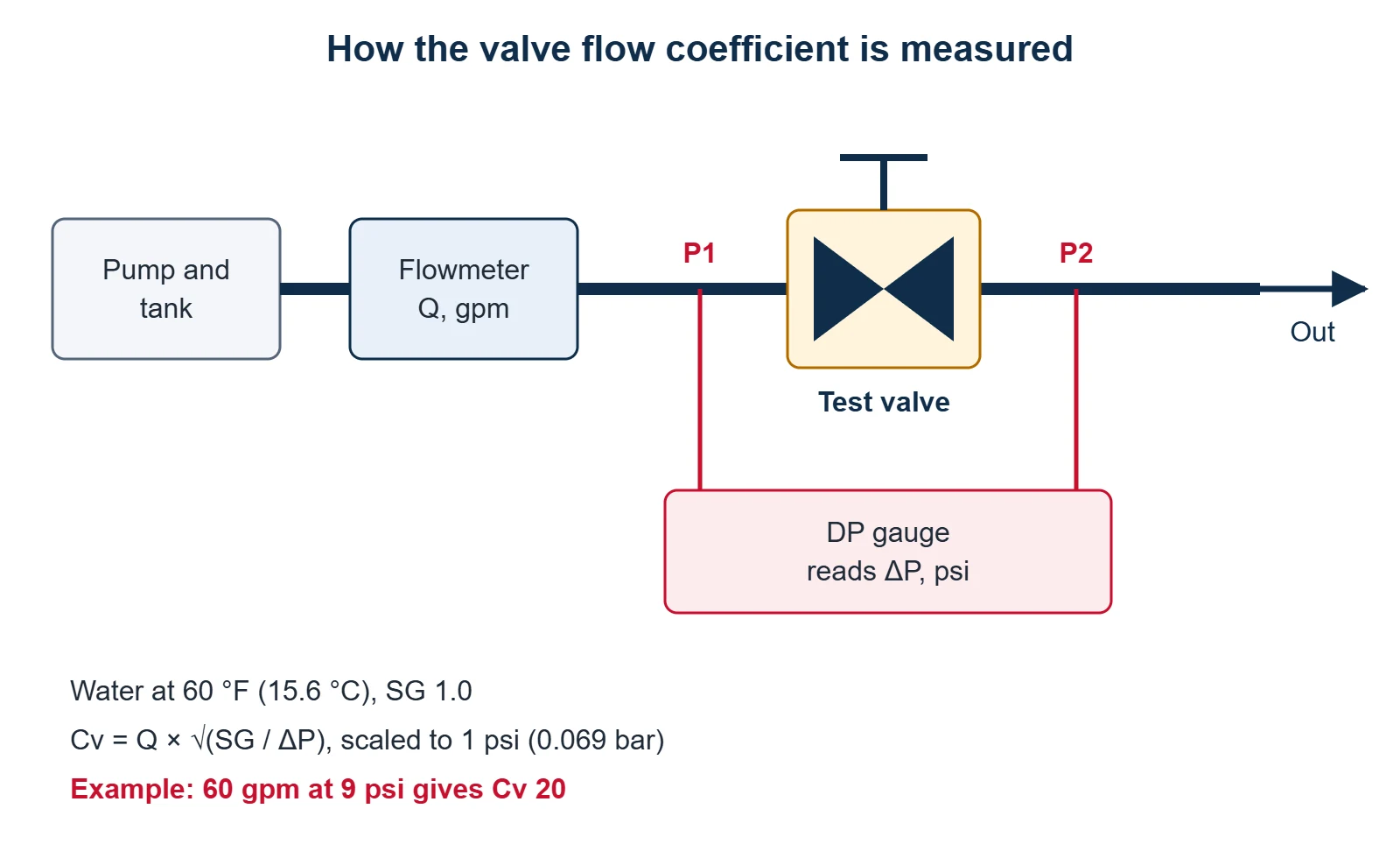
The valve flow coefficient comes from a test bench: a flowmeter reads the water rate, a differential gauge reads the drop, and the result is scaled to 1 psi.
What is the formula for valve flow coefficient?
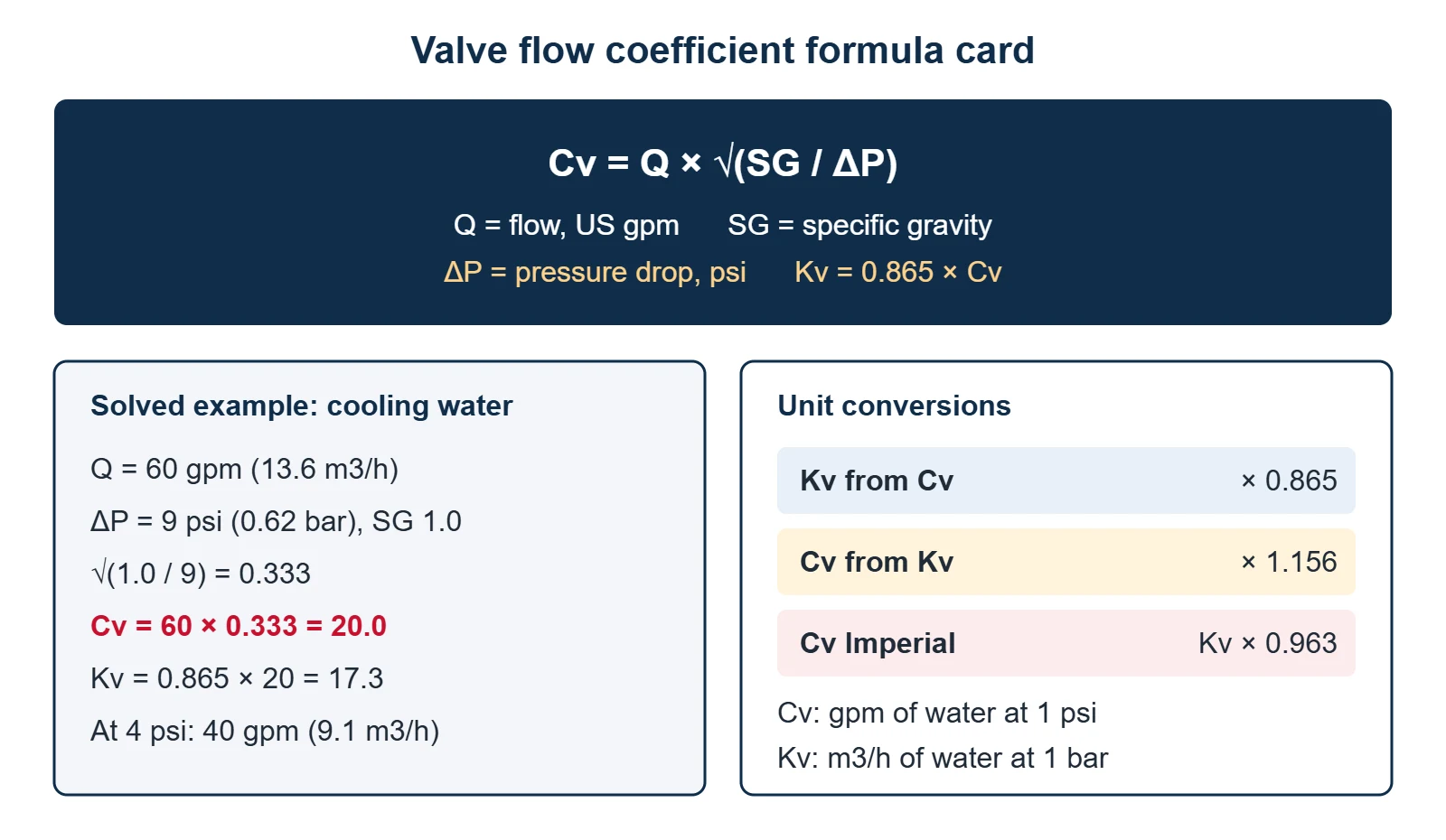
For a liquid, the valve flow coefficient equals the flow in gpm times the square root of specific gravity divided by pressure drop in psi. Rearrange it to get the flow a known valve flow coefficient will pass.
Cv = Q × √(SG / ΔP)
Q = Cv × √(ΔP / SG)
Q = liquid flow, US gpm
SG = specific gravity, water at 60 °F = 1.0
ΔP = pressure drop across the valve, psi
Kv = 0.865 × Cv, Cv = 1.156 × Kv
This is equation (1) on the Engineering ToolBox page, and it is the same liquid relation the Fisher Catalog 12 sizing section writes with a numerical constant N1 of 1.00 for gpm and psi. In that catalog, N1 becomes 0.865 when you work in m3/h and bar.
The square root is the part people forget. Doubling the pressure drop raises the flow by only about 41 percent, because flow follows the square root of ΔP across a fixed valve flow coefficient.
Specific gravity matters too. A liquid heavier than water needs a larger valve flow coefficient for the same gpm, and a lighter liquid needs a smaller one.
How do you convert Cv to Kv?
Multiply Cv by 0.865 to get Kv, or multiply Kv by 1.156 to get Cv. Kv is the metric valve flow coefficient, in m3/h of water at a 1 bar drop.
The Fisher catalog prints the relation as Kv = 0.865 × Cv, and Spirax Sarco lists Cv (US) = Kv × 1.156. Engineering ToolBox rounds the same pair to 0.862 and 1.16, so small differences between references are rounding, not a different valve flow coefficient.
Spirax Sarco also notes an Imperial Cv equal to Kv × 0.963, so confirm which gallon a datasheet means before you compare one valve flow coefficient with another.
| Unit | Definition | Convert |
|---|---|---|
| Cv (US) | US gpm of water at 1 psi (0.069 bar) drop | Cv = 1.156 × Kv |
| Kv | m3/h of water at a 1 bar drop | Kv = 0.865 × Cv |
| Cv (Imperial) | Imperial gallons per minute at 1 psi | Cv(Imp) = 0.963 × Kv |
| Kvs | Valve flow coefficient (Kv) when fully open | Read from the datasheet |
How do you calculate valve flow coefficient? A solved example
You calculate the valve flow coefficient by plugging the design flow, the specific gravity and the allowed pressure drop into Cv = Q × √(SG / ΔP). Below, we size a cooling water control valve and then a small needle valve.
Solved example
A cooling water loop needs 60 gpm (13.6 m3/h) of water, SG 1.0, and the control valve may take 9 psi (0.62 bar) of drop at that flow.
- Write the formula: Cv = Q × √(SG / ΔP).
- Divide SG by ΔP: 1.0 / 9 = 0.111.
- Take the square root: √0.111 = 0.333.
- Multiply by flow: valve flow coefficient Cv = 60 × 0.333 = 20.0.
- Convert to metric: Kv = 0.865 × 20.0 = 17.3, which matches 13.6 m3/h divided by √0.62 = 17.3.
- Check the other way: a valve flow coefficient of 20 at 4 psi (0.28 bar) passes 20 × √4 = 40 gpm (9.1 m3/h).
Second case: a sample line needs 0.5 gpm (0.11 m3/h) of water at a 25 psi (1.72 bar) drop, so the valve flow coefficient is 0.5 × √(1 / 25) = 0.10.
The required valve flow coefficient of 20 is the minimum the valve must offer at maximum flow. The control.com textbook works the same type of problem, 470 gpm at a 10.8 psi drop, and finds a Cv of at least 143.
For the sample line, Swagelok’s integral bonnet needle valve catalog lists a Cv of 0.09 for a 0.080 inch (2.0 mm) orifice and 0.37 for a 0.172 inch (4.4 mm) orifice. Wide open, the 0.09 valve falls just short of 0.10, so take the 0.172 inch orifice and you have room to throttle.
Valve flow coefficient calculator
Give it any three of flow, pressure drop, specific gravity and Cv or Kv, and the calculator below solves the fourth. Enter 60 gpm, 9 psi and SG 1.0 and you should see the same valve flow coefficient of 20 from the solved example.
The calculator uses the liquid equation only. Its page states that it applies to liquids that are not flashing or cavitating, and that gas and steam need other equations.
How does the valve flow coefficient work for gas and steam?
The valve flow coefficient is still defined with water, but gas and steam need equations that use absolute pressure, temperature and a choked flow limit. You cannot drop scfm into the liquid formula.
The Wikipedia article on flow coefficient gives a quick field check: for air at room temperature, with outlet pressure below half the absolute inlet pressure, a Cv of 1.0 at 200 psia (13.8 bar a) inlet passes about 100 scfm (2.83 standard m3/min). In that choked range, flow rises in proportion to absolute inlet pressure, not to the square root of the drop.
For subcritical gas, Engineering ToolBox gives Cv = q × √(SG × (T + 460)) / (1360 × √(ΔP × P2)), with q in scfh, T in °F and pressures in psia. For saturated steam at choked flow, the same site gives Cv = m / (1.61 × P1), with m in lb/hr and P1 in psia.
How do you use Cv to pick an instrument valve or needle valve?
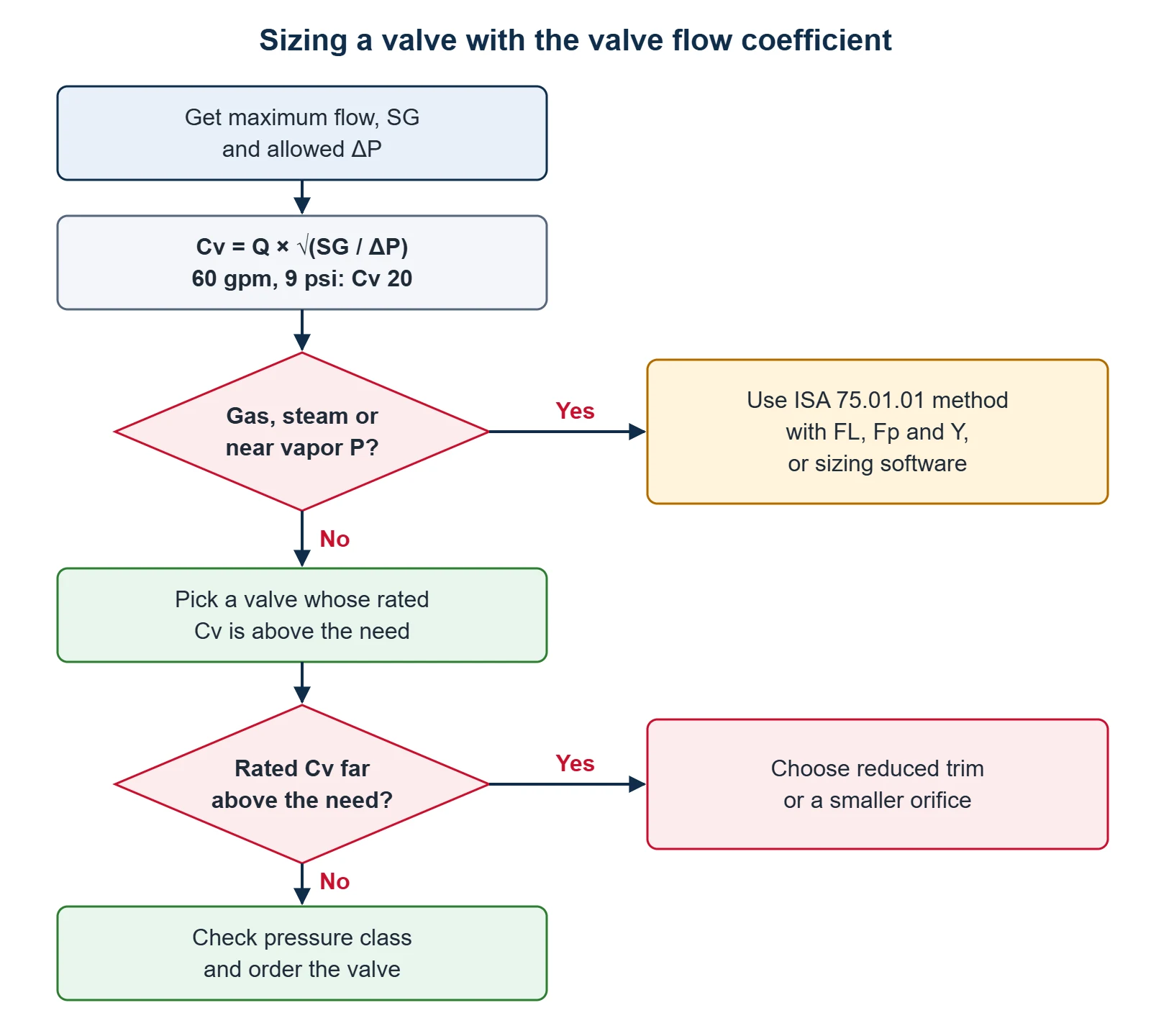
Calculate the valve flow coefficient you need at maximum flow, then choose a valve whose rated Cv is above it but not far above it. For instrument and needle valves, also check the orifice size, the pressure class and the turns open curve.
Start with the real service. An impulse line to a pressure transmitter carries almost no flow, so the valve flow coefficient barely matters; there you care about bore, rating and leak tightness.
A purge, sample or bleed line is different, because you are setting a flow. Our guide on needle valve working and types covers stem tips, and the Swagelok catalog plots the valve flow coefficient against turns open, so you can see how much travel you will use.
Pick the smallest orifice whose full open valve flow coefficient still covers your maximum case. The Swagelok range runs from a Cv of 0.09 to 1.80, a wide spread inside one family of instrument valves and manifolds.
That same catalog lists 316 stainless needle valves up to 6,000 psig (413 bar) at 100 °F (37.8 °C). A Cv figure is only useful if the valve is also rated for the line.
How does ISA 75 sizing go beyond the simple formula?
ANSI/ISA 75.01.01 keeps the same valve flow coefficient but adds correction factors for piping, choked flow and gas expansion. The Fisher catalog notes that the ISA standard is harmonized with IEC 60534-2-1.
In the ISA style equation, the liquid form reads Cv = q / (N1 × Fp × √(ΔP / Gf)). Fp corrects for reducers next to the valve, and FL, the liquid pressure recovery factor, sets the drop at which the liquid starts to vaporize and the flow chokes.
We treat the simple valve flow coefficient formula as a first pass. For a real automatic control valve with a large drop, hot water or gas, run the ISA 75 method or the maker’s sizing program before you buy.
The plug and seat set the rated valve flow coefficient, and this overview of the basic parts of a control valve shows where they sit.
Why does a valve not deliver its rated flow?
Most shortfalls come from a pressure drop lower than assumed, choked or cavitating flow, or a partly closed or fouled valve. These are the ones we see most often in the field.
| Symptom | Likely cause | Fix |
|---|---|---|
| Flow short even with the valve wide open | Actual ΔP lower than the design ΔP | Measure ΔP with a differential pressure gauge and recalculate the valve flow coefficient |
| Flow stops rising as ΔP rises | Choked flow, flashing or cavitation | Size with ISA 75 factors (FL) instead of the simple formula |
| Loop hunts at low flow | Rated valve flow coefficient far above the need | Use reduced trim or a smaller valve body |
| Needle valve does nothing for the first turns | Orifice too large for the flow | Choose a smaller orifice with a lower valve flow coefficient |
| Gas flow lower than predicted | Liquid formula used for gas | Use absolute pressure and the gas equation |
When you check a valve in service, read the flow from a flowmeter at the same moment you read ΔP. With both numbers you can back out the working valve flow coefficient and compare it with the datasheet curve.
Pros and cons of sizing by valve flow coefficient
Sizing by valve flow coefficient is fast and lets you compare any two valves on one scale. It is approximate for gases, hot liquids and large drops.
Pros
- One valve flow coefficient compares globe, ball and needle valves
- The liquid formula needs only flow, SG and ΔP
- Cv and Kv convert with one factor
- Field checks need only a flowmeter and a DP reading
Cons
- Simple formula ignores choked flow and cavitation
- Gas and steam need separate equations
- Datasheet Cv is usually the fully open value
- Reducers next to the valve change the real capacity
The control.com textbook adds a size rule of thumb, Cv ≈ d² × Cd, with Cd near 9.5 for a single port globe valve, 30 for a standard port ball valve and 40 for an unoffset butterfly. That is why a 2 inch (50.8 mm) ball valve has a far higher valve flow coefficient than a 2 inch globe valve.
Myth vs fact: valve flow coefficient
Most errors with the valve flow coefficient come from treating it as a fixed flow limit. These four come up often.
The valve flow coefficient is the most flow the valve can ever pass.
Flow rises with the square root of ΔP; a Cv 20 valve passes 60 gpm at 9 psi.
A bigger valve flow coefficient is always safer.
An oversized valve throttles near its seat, where stem friction and calibration error count most.
Cv and Kv are the same number.
Kv = 0.865 × Cv, so a valve flow coefficient of 20 is a Kv of 17.3.
The liquid formula works for air if you use scfm.
Gas needs absolute pressure, temperature and a choked flow check.
Industrial applications of the valve flow coefficient
Every plant that throttles a fluid uses the valve flow coefficient, from large control valves to tiny metering valves. Four cases we see often:
Refinery
Hydrocarbon sample lines use needle valves sized by Cv so the analyzer gets a steady, fresh flow. The low SG of light products lowers the valve flow coefficient you need.
Water and wastewater plant
Chemical dosing and filter rate valves are sized from flow and available head. Kv is common on metric skids, so the 0.865 factor gets used daily.
HVAC
Chilled water coil valves are picked by Cv at the design gpm and the allowed valve drop. A valve flow coefficient that is too large makes the coil control poorly at part load.
Chemical plant
Reactor feed globe valves handle liquids near vapor pressure, so ISA 75 factors are checked for choked flow.
Frequently asked questions
What is the valve flow coefficient and why does it matter?
The valve flow coefficient is the gpm of 60 °F water a valve passes at a 1 psi drop. It matters because it links flow, pressure drop and valve size in one number, so you can compare valves from any maker and check whether a valve will pass your design flow.
How do you calculate the Cv of a valve by hand?
Use Cv = Q × √(SG / ΔP) with flow in gpm and drop in psi. For 60 gpm (13.6 m3/h) of water at 9 psi (0.62 bar), the square root of 1/9 is 0.333, so the valve flow coefficient is 20. Then pick a valve rated above 20.
What is the difference between Cv and Kv for valves?
Cv uses US gallons per minute at a 1 psi drop, while Kv uses cubic meters per hour at a 1 bar drop. They describe the same valve flow coefficient in different units. Multiply Cv by 0.865 to get Kv, or multiply Kv by 1.156 to get Cv.
Does a higher Cv mean the valve passes more flow?
Yes, at the same pressure drop and fluid, a higher Cv passes more flow in direct proportion. A Cv 40 valve passes twice the flow of a Cv 20 valve at the same drop. Too high a valve flow coefficient for the job, though, leaves the valve throttling close to its seat.
Can you use the liquid Cv formula for air or gas?
No, gas changes density as pressure falls, so you need the gas form with absolute pressures and temperature. As a field check, Wikipedia notes that a Cv of 1.0 at 200 psia (13.8 bar a) passes about 100 scfm of air when outlet pressure is below half the inlet.
Which standard covers control valve sizing with flow coefficients in the US?
ANSI/ISA 75.01.01 gives the flow equations for sizing control valves and is harmonized with IEC 60534-2-1. It adds factors for reducers, liquid pressure recovery, choked flow and gas expansion, so it gives better answers than the basic formula for gas, steam, hot water and high drops.