
Vortex Flow Meter: Working Principle, K-Factor & Sizing
Table of Contents
- How does a vortex flow meter work?
- What is a vortex flow meter?
- What is the Strouhal number in a vortex flow meter?
- What is K factor in vortex flow meter?
- What is the minimum Reynolds number for a vortex flow meter?
- How to size a vortex flow meter?
- How do you calculate vortex flow meter frequency and K-factor? A solved example
- Solved example
- Vortex shedding frequency calculator
- How much straight pipe does a vortex flow meter need?
- How do you test a vortex flow meter?
- Pros and cons of a vortex flow meter
- Pros
- Cons
- Myth vs fact: vortex flow meter
- Industrial applications of the vortex flow meter
- Refinery
- Water and wastewater plant
- HVAC
- Chemical plant
- Frequently asked questions
- What is the working principle of a vortex flow meter?
- Can a vortex flow meter measure steam and gas as well as liquids?
- Why does my vortex flow meter read zero at low flow?
- Can you install a vortex flow meter in a vertical pipe?
- How accurate is a vortex flow meter on water and steam?
- Do you need to recalibrate a vortex flow meter after years in service?
A vortex flow meter counts the swirls that peel off a fixed bar in the pipe, and that pulse rate tells you the flow. For plant engineers, technicians and buyers, the questions that matter are how it works, what the K-factor means and how to size one so it reads correctly at minimum flow.
The idea is old physics put to work. Endress+Hauser notes that Leonardo da Vinci sketched vortices behind obstacles in 1513, and that Strouhal tied oscillation frequency to velocity in 1878.
How does a vortex flow meter work?
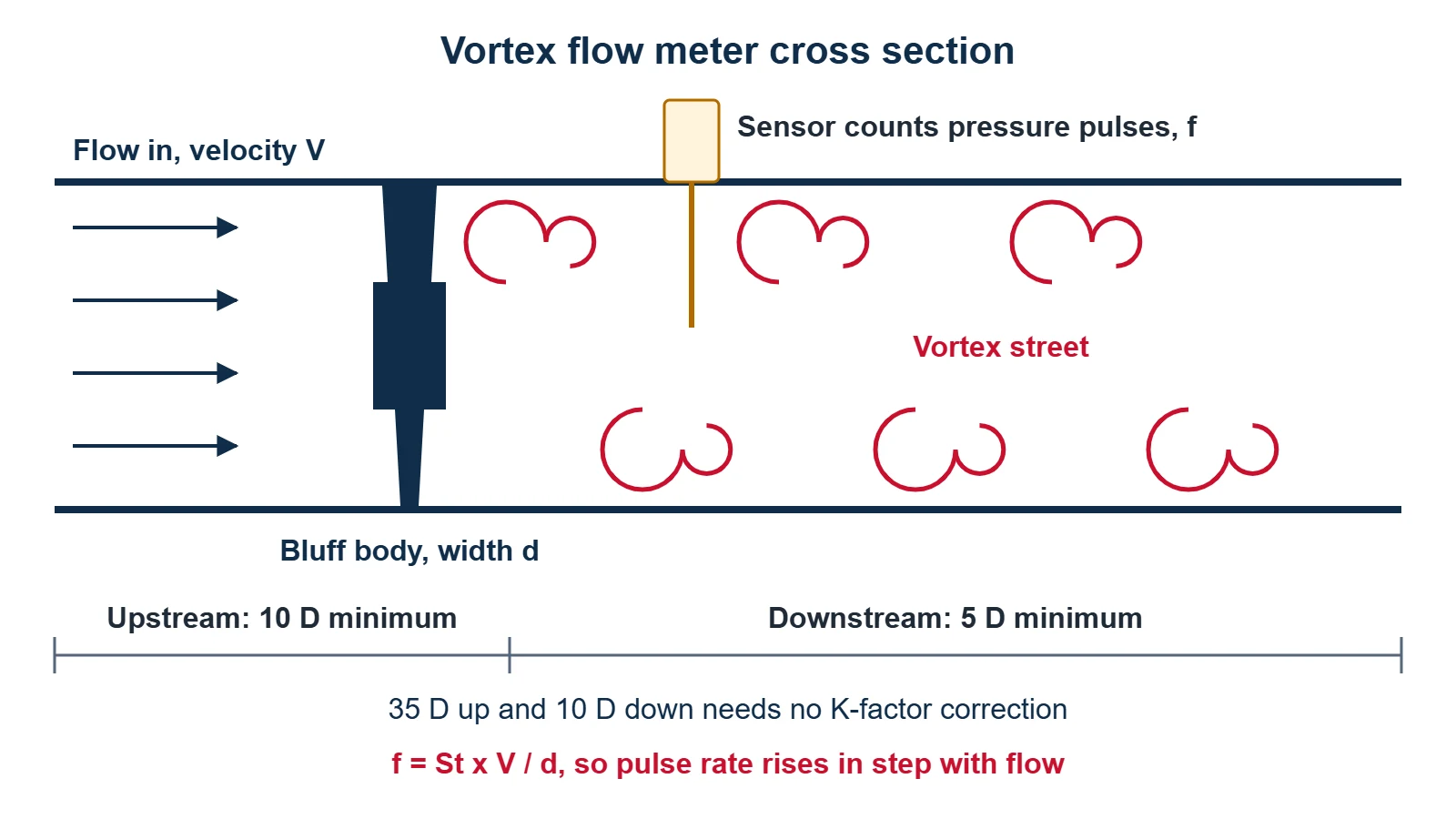
A vortex flow meter places a bluff body across the pipe, and as fluid passes it, vortices shed alternately from each side at a frequency proportional to velocity. A sensor counts those pressure pulses, and the factory K-factor converts pulses into volume. It works on liquids, gases and steam when the Reynolds number stays above roughly 10,000 and the straight pipe run meets the datasheet.
What is a vortex flow meter?
A vortex flow meter is a volumetric flowmeter with no moving parts that infers flow from the frequency of vortices shed by a bluff body. Inside the body you find three things: the bluff body (also called a shedder bar), a sensor that feels the alternating pressure, and electronics that count pulses.
Engineers also call it a vortex shedding flow meter. The vortex flow meter belongs in the same family as our industrial flowmeters, and it often feeds a pulse or 4 to 20 mA signal to a flow transmitter or DCS input.
Because the vortex flow meter measures volume, steam and gas users usually add pressure and temperature to get mass or energy. Endress+Hauser points out that vortex meters have been widely used on steam since the 1980s and are replacing orifice plates where an easier install and wider turndown matter.
What is the Strouhal number in a vortex flow meter?
The Strouhal number (St) is the dimensionless ratio that links shedding frequency, velocity and bluff body width. For a vortex flow meter, St stays nearly constant across a wide Reynolds range, which is why the output is linear.
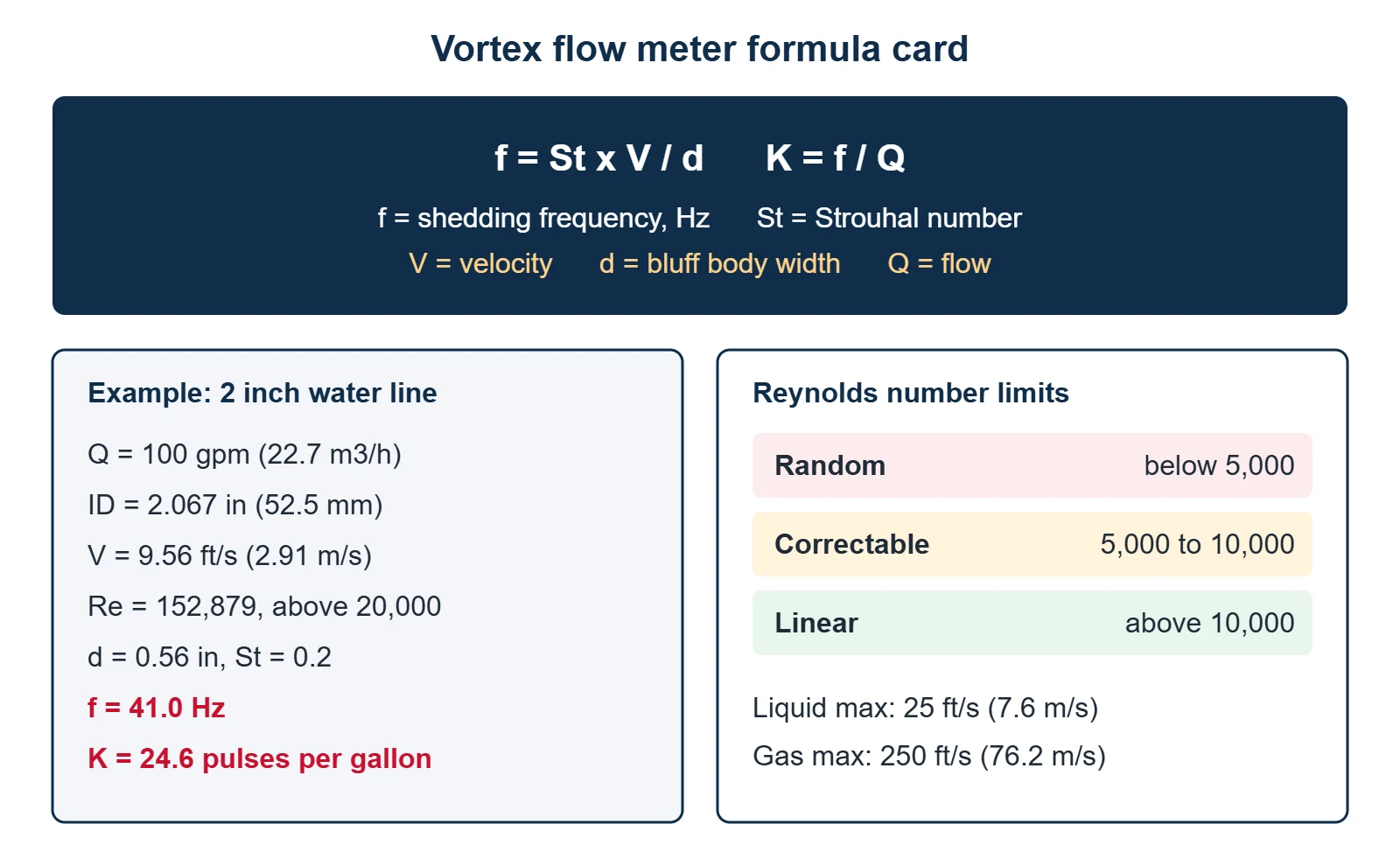
f = St × V / d
Q = A × V, so K = f / Q (pulses per unit volume)
Where: f = shedding frequency, Hz; St = Strouhal number; V = mean velocity, ft/s (m/s); d = bluff body width, ft (m); A = pipe flow area; Q = volume flow, gpm (m3/h)
The Strouhal number reference gives a value close to 0.2 for a plain cylinder over roughly four orders of magnitude in Reynolds number. Real shedder bars are shaped, so each vortex flow meter has its own effective value, which the factory captures in the K-factor.
Double the velocity and the shedding frequency doubles, so the vortex flow meter needs no square root extraction like a DP meter.
What is K factor in vortex flow meter?
The K-factor is the number of pulses the vortex flow meter produces per unit volume, set by wet calibration and stamped on the nameplate. It depends on the bluff body shape and line size, not on the fluid, as long as the Reynolds number stays in the linear range.
Endress+Hauser gives a clear case: a DN 50 (2 inch) meter with K = 10 pulses per liter delivers 0.1 liter per pulse. To get flow rate, divide the pulse frequency by K.
The K-factor does drift with temperature because the metal body grows. The Rosemount 8800C product data sheet lists a change of 0.23 to 0.27 percent per 100 °F (55.6 °C), so the transmitter corrects for process temperature you enter.
What is the minimum Reynolds number for a vortex flow meter?
Most makers want a Reynolds number above about 10,000 for a linear vortex flow meter, and larger sizes often need 20,000. Below about 5,000 the shedding becomes random and the vortex flow meter cannot measure.
The Endress+Hauser vortex measuring principle page splits the range into three zones. Above 10,000 the Strouhal number is constant, from 5,000 to 10,000 an extra error appears that can be compensated, and below 5,000 measurement is impractical.
Emerson sets a 10,000 floor for 1/2 to 4 inch sizes and 20,000 for 6 to 12 inch sizes. For liquids it quotes plus or minus 0.65 percent of rate above Re 20,000, so the vortex flow meter loses some accuracy close to the floor.
If you need a refresher on the formula, our post on Reynolds number and flow regimes walks through it with a calculator. Viscous oils are the usual trap, because high viscosity pulls Re down fast at low flow.
How to size a vortex flow meter?
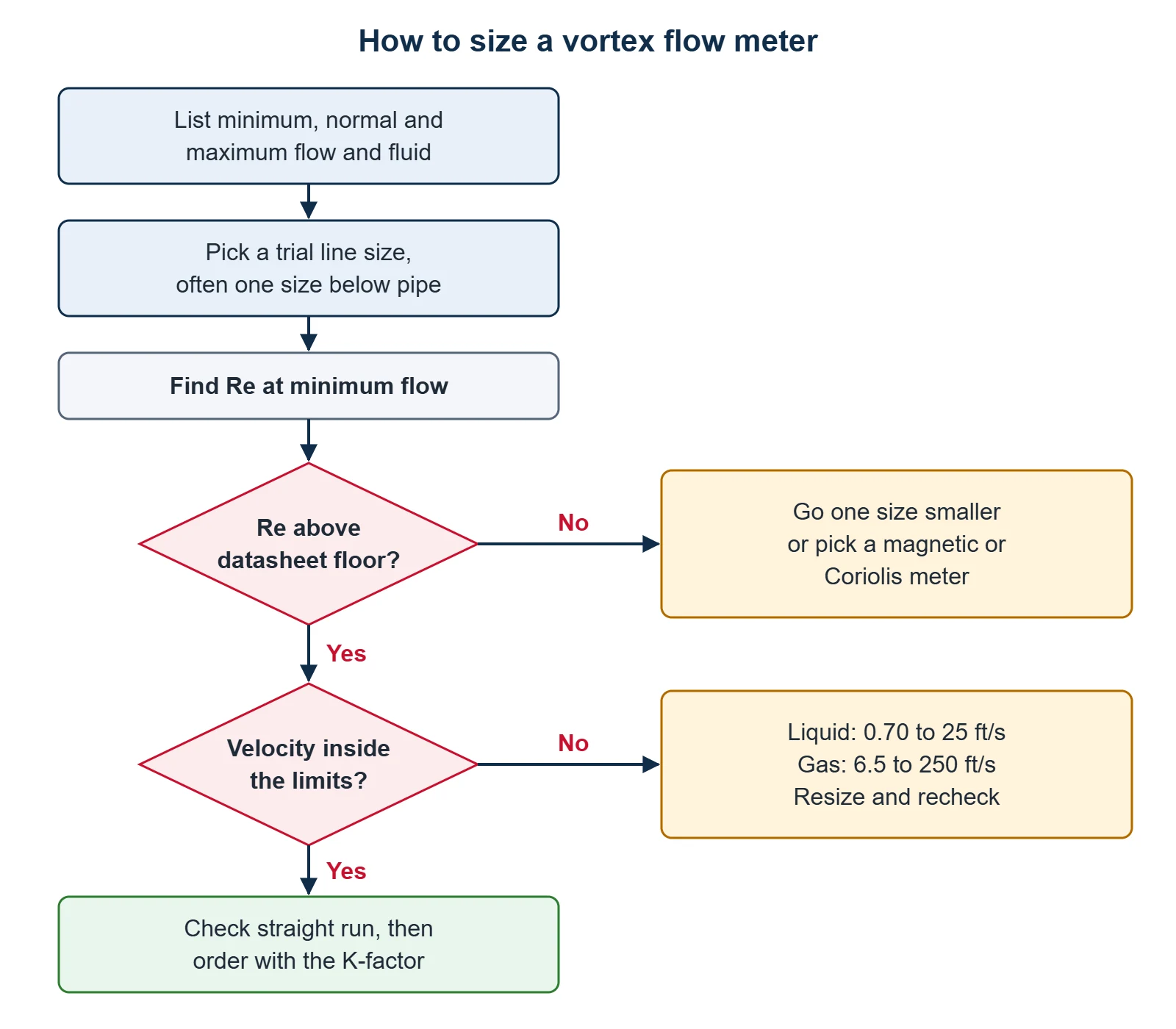
Size a vortex flow meter by flow range, not by pipe size: check that the Reynolds number at minimum flow is above the datasheet floor and that velocity at maximum flow stays below the limit. The vortex flow meter size falls out of that check, and it is often one size smaller than the pipe.
Here is the order we follow on every job:
- Write down minimum, normal and maximum flow, plus density and viscosity at the worst case (coldest for liquids, lowest pressure for gas).
- Pick a trial vortex flow meter size and find the bore velocity at each flow.
- Calculate Re at minimum flow and compare it with the datasheet floor.
- Check velocity limits: Emerson lists 0.70 to 25 ft/s (0.21 to 7.6 m/s) for liquids and 6.5 to 250 ft/s (1.98 to 76.2 m/s) for gases.
- If minimum flow fails, go one size smaller, then recheck pressure drop and the maximum velocity.
Endress+Hauser adds a cavitation warning: liquid above 30 ft/s (9 m/s) can cavitate behind the bar of a vortex flow meter and cause errors. On gas, velocity above about 245 ft/s (75 m/s) usually costs too much pressure loss to be worth it.
How do you calculate vortex flow meter frequency and K-factor? A solved example
Find velocity from flow and bore, confirm the Reynolds number, then apply f = St × V / d and divide by flow to get K. The example below uses cold water in a 2 inch Schedule 40 line.
Solved example
Water at 68 °F (20 °C), SG 1.0, viscosity 1.0 cP, flowing at 100 gpm (22.7 m3/h) through a 2 inch vortex flow meter with a bore of 2.067 in (52.5 mm). Assume a shedder bar width of 0.56 in (14.2 mm) and St = 0.2.
- Velocity: V = 0.4085 × 100 / 2.067² = 9.56 ft/s (2.91 m/s).
- Reynolds number: Re = 3160 × 100 × 1.0 / (2.067 × 1.0) = 152,879, well above the 20,000 needed for best accuracy.
- Shedding frequency: f = 0.2 × 9.56 / (0.56 / 12) = 41.0 Hz.
- Flow in gallons per second: 100 / 60 = 1.667 gal/s.
- K-factor: K = 41.0 / 1.667 = 24.6 pulses per gallon (6.49 pulses per liter).
That K value sits in the same range as the 10 pulses per liter Endress+Hauser quotes for a DN 50 body. On a real vortex flow meter you read K off the calibration sheet for billing instead of calculating it, but this check catches a wrong K typed into a flow computer.
Now check turndown on the same size. Emerson’s water table for a 2 inch flanged body runs from 7.96 to 261 gpm, about 33 to 1, and at 7.96 gpm our bore gives Re 12,169, still above the 10,000 floor.
Vortex shedding frequency calculator
Enter velocity, bluff body width and Strouhal number to get the shedding frequency, and add the pipe inside diameter to see volume flow and pulses per liter. Plug in 9.56 ft/s, 0.56 in, 0.2 and 2.067 in to reproduce the vortex flow meter example above.
How much straight pipe does a vortex flow meter need?
Plan on at least 10 pipe diameters upstream and 5 downstream of a vortex flow meter, with more upstream after elbows, reducers or partly open valves. Emerson states that 35 diameters upstream and 10 downstream need no K-factor correction at all.
Endress+Hauser quotes 10 to 40 diameters upstream depending on the disturbance, and says a perforated plate flow conditioner can cut the upstream run to about 10 diameters. Put control valves downstream, never upstream, because a throttling valve makes swirl that the vortex flow meter reads as flow.
Put the pressure and temperature taps for density compensation downstream of the meter body, where they do not disturb the profile, and follow the manual for exact distances. Our pressure transmitters and thermowells fit those taps on steam lines.
How do you test a vortex flow meter?
Start with the zero flow check: with the line full and blocked in, the vortex flow meter should read zero. Then compare the reading with a known flow, such as a tank draw down, and confirm the K-factor in the transmitter matches the nameplate.
If the reading still looks wrong at the control system, rule out the analog signal too, and our sister blog shows how a 4 to 20 mA current loop carries it.
| Symptom | Likely cause | Fix |
|---|---|---|
| Reads flow at zero flow | Pipe vibration or pump pulsation picked up by the sensor | Raise the low flow cutoff, add pipe supports, adjust signal filter settings |
| Drops to zero at low flow | Reynolds number below the floor or velocity under the minimum | Recalculate Re at minimum flow; fit a smaller vortex flow meter |
| Reads high on liquid | Entrained gas or flashing behind the bar | Raise back pressure, move the meter to a lower point, check for cavitation above 30 ft/s |
| Steady offset after years of service | Erosion rounding the bluff body edges or buildup changing K | Inspect and clean the shedder bar; recalibrate or replace the body |
| Erratic reading after a pipe change | Short straight run or a valve upstream | Restore 10 D upstream minimum or add a flow conditioner |
| Wrong total vs tank gauge | Wrong K-factor or units in the flow computer | Enter the nameplate K and confirm with the f = St × V / d check |
Endress+Hauser notes that edges rounded by up to 0.08 in (2 mm) add about plus or minus 0.3 percent error, so look at the bar on every shutdown. For a wider list of meter faults, see our guide to troubleshooting flow meters.
Pros and cons of a vortex flow meter
A vortex flow meter gives you a linear, no moving parts measurement on liquid, gas and steam, but it needs turbulent flow and a decent straight run.
Pros
- No moving parts, so little wear on clean fluids
- Linear pulse output, no square root extraction
- Handles steam, gas and liquid in one design
- Emerson lists process temperatures up to 800 °F (427 °C) on extended bodies
- Turndown near 33 to 1 on water in a 2 inch size
Cons
- Cuts out below its minimum Reynolds number and velocity
- Poor fit for viscous oils and slurries
- Sensitive to pipe vibration and pulsation
- Needs density compensation for mass on gas and steam
- Permanent pressure loss from the bluff body
Myth vs fact: vortex flow meter
Most bad vortex flow meter installs trace back to a handful of beliefs that sound right but are not. These are the ones we correct most often.
Buy the vortex flow meter in the same size as the pipe.
Size by flow range. A line size meter often fails the Reynolds or velocity minimum at low flow, so one size smaller is common.
The K-factor changes with every fluid.
Endress+Hauser states K depends on bluff body shape and size, not the fluid, while Re stays in the linear range.
A vortex flow meter reads mass flow on steam.
It measures volume. You need pressure and temperature compensation to report mass or energy.
No moving parts means no maintenance.
Erosion and buildup on the shedder bar shift K, so inspect it during shutdowns.
Industrial applications of the vortex flow meter
The vortex flow meter earns its place on steam, utility gas and clean liquids where a magnetic meter cannot work or an orifice plate gives too little turndown. These four cases are typical.
Refinery
Plants meter steam to reboilers and tracing headers with a vortex flow meter plus pressure and temperature compensation. It also measures fuel gas and hydrocarbon liquids that are not conductive enough for a mag meter.
Water and wastewater plant
Blower air to aeration basins suits a vortex flow meter because the air is clean and turbulent. A vortex flow meter also handles demin water, which has too little conductivity for many mag meters.
HVAC
Campus boiler plants use a vortex flow meter on steam for energy billing between buildings. The linear pulse output feeds a BTU computer directly.
Chemical plant
Nitrogen, compressed air and process steam headers use a vortex flow meter for cost allocation. Units with flanged ASME Class 150 to 1500 bodies cover high pressure service.
Where the line is dirty, add a strainer upstream far enough away that it does not eat into the straight run. For low flow or high viscosity duty, a orifice plate or Coriolis meter is often the better call.
Frequently asked questions
What is the working principle of a vortex flow meter?
A vortex flow meter works on the von Karman effect: a bluff body sheds vortices alternately from each side at a frequency proportional to velocity. A sensor counts the pressure pulses, and the calibrated K-factor turns pulses into volume flow. The Strouhal number stays constant above about Re 10,000, so the output is linear.
Can a vortex flow meter measure steam and gas as well as liquids?
Yes. A vortex flow meter is a common choice for steam, compressed air, natural gas, nitrogen and clean liquids, and you add pressure and temperature inputs to report mass or energy. Emerson lists a gas velocity window of 6.5 to 250 ft/s for its 8800C line.
Why does my vortex flow meter read zero at low flow?
At low flow the Reynolds number or velocity drops below the meter floor, and the transmitter low flow cutoff blanks the signal. Below about Re 5,000 shedding becomes random. Check your minimum flow against the datasheet and consider a smaller body or a reducer style meter to raise the bore velocity.
Can you install a vortex flow meter in a vertical pipe?
Yes, most can go vertical, but on liquid the flow should run upward so the pipe stays full and gas does not gather at the sensor. On gas and steam either direction usually works if condensate can drain. Keep the same 10 diameters upstream and 5 downstream minimum straight run.
How accurate is a vortex flow meter on water and steam?
Emerson quotes plus or minus 0.65 percent of rate on liquids above Re 20,000 and 1.35 percent on gas and steam, for pulse or digital output. Endress+Hauser lists 0.75 percent of reading for delta bluff bodies. Accuracy falls near the Reynolds floor, so size for that margin.
Do you need to recalibrate a vortex flow meter after years in service?
The K-factor is fixed by geometry, so routine field calibration is not usually needed on clean service. Erosion, deposits or a bent shedder bar change K, though. Inspect the bar on shutdowns, verify the transmitter against a known reference with a frequency calibrator, and send the body back for wet calibration if damage shows.